
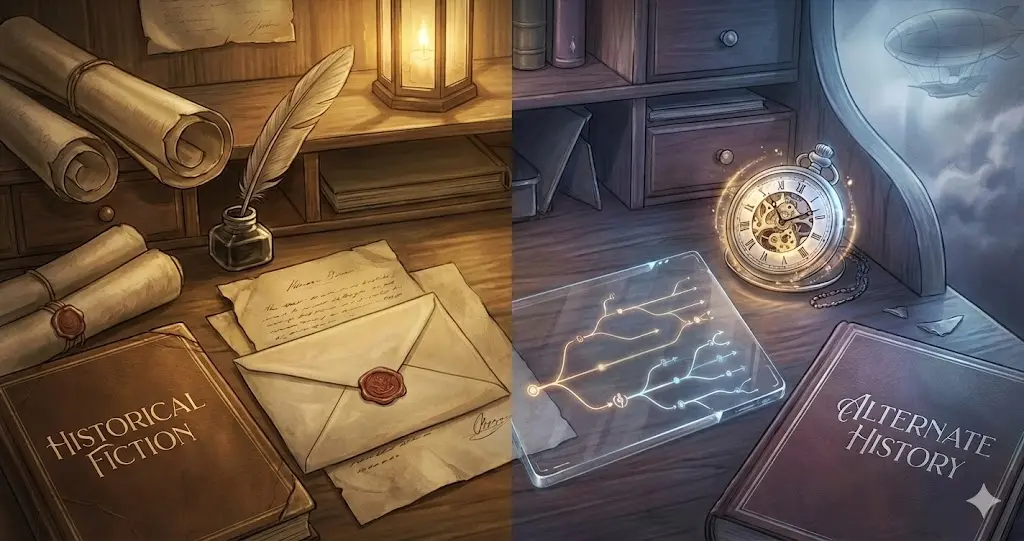

If you’ve ever found yourself confused about whether a book is historical fiction or alternate history, you’re not alone. These two genres share common ground; both are rooted in the past, but they take fundamentally different approaches to storytelling. While historical fiction aims to recreate actual events and time periods as authentically as possible, alternate history asks the provocative question: “What if things had happened differently?”
Understanding the distinction between these genres helps readers find books that match their interests and helps writers craft stories that meet genre expectations. Whether you’re drawn to meticulously researched accounts of real historical events or fascinated by imaginative explorations of how history could have unfolded differently, knowing these differences will enhance your reading experience.
This comprehensive guide breaks down the key distinctions between historical fiction and alternate history, explores notable examples of each, and helps you identify which genre best suits your reading preferences.
Disclosure: This article contains affiliate links. We earn from qualifying purchases at no extra cost to you.What Is Historical Fiction?
Historical fiction is a literary genre that sets its narrative in a specific historical period and strives to accurately represent the time, place, culture, and events of that era. The defining characteristic of historical fiction is its commitment to historical accuracy within the framework of a fictional story.
Core Elements of Historical Fiction
Authentic Historical Setting Historical fiction transports readers to actual time periods in human history. Authors invest significant research into recreating the sights, sounds, customs, language, and social norms of their chosen era. The setting isn’t merely a backdrop; it is integral to the story.
Real Historical Events: Although the main characters may be fictional, the historical events that surround them are real. These novels often feature major historical moments, wars, revolutions, social movements, and political upheavals as they actually occurred.
Period-Accurate Details From clothing and architecture to social hierarchies and daily life, historical fiction maintains authenticity. Authors consult primary sources, historical documents, and scholarly research to ensure their depictions ring true to the period.
Plausible Within Historical Context: Everything that happens in a historical fiction novel could have plausibly happened during that time period. The story respects the boundaries of what was historically possible.
Examples of Historical Fiction
- “The Pillars of the Earth” by Ken Follett – Set in 12th-century England during the Anarchy, depicting the construction of a cathedral
- “All the Light We Cannot See” by Anthony Doerr – World War II story following a blind French girl and a German soldier
- “Wolf Hall” by Hilary Mantel – Chronicles Thomas Cromwell’s rise to power in Tudor England under Henry VIII
- “The Nightingale” by Kristin Hannah – Two sisters in Nazi-occupied France during World War II
For a deeper understanding of this genre, read our complete guide: What Is Historical Fiction?
What Is Alternate History?
Alternate history (also called alternative history or “alt-history”) is a speculative fiction genre that explores how history might have unfolded differently if a specific historical event had occurred in a different manner. It asks “What if?” and then imagines the consequences.
Core Elements of Alternate History
Point of Divergence: Every alternate history story has a “point of divergence,” a specific moment where history branched away from what actually happened. This could be a battle with a different outcome, an assassination that succeeded or failed, a discovery made earlier or later, or any pivotal moment reimagined.
Speculative Consequences From that single changed event, the author traces logical consequences through history, imagining how society, politics, technology, and culture might have developed differently. The further from the point of divergence, the more dramatically history may differ from our reality.
Counter-Factual History: Alternate history essentially creates a counter-factual historical timeline. It requires the same historical research as historical fiction, but then deliberately deviates to explore possibilities that never came to pass.
Often Combines with Other Genres. Alternate history often blends with other genres such as science fiction, fantasy, thriller, or mystery, depending on the nature of the divergence and its consequences.
Examples of Alternate History
- “The Man in the High Castle” by Philip K. Dick – Explores a world where the Axis powers won World War II
- “Fatherland” by Robert Harris – Set in 1964 in a world where Nazi Germany won WWII
- “11/22/63” by Stephen King – A time-travel novel attempting to prevent JFK’s assassination
- “The Yiddish Policemen’s Union” by Michael Chasin – Set in an alternate Alaska where a temporary Jewish settlement became permanent
Key Differences Between Historical Fiction and Alternate History
1. Relationship to Historical Truth
Historical Fiction:
- Adheres to known historical facts and events
- Fictional elements exist within the framework of what actually happened
- Research aims to recreate history as accurately as possible
- The past is fixed; the story explores what life was like within those historical constraints
Alternate History:
- Deliberately changes one or more historical events
- Explores counter-factual scenarios: “What if this happened instead?”
- Creates an entirely different timeline from a specific divergence point
- The past is malleable; the story explores how things could have been different
2. Historical Events
Historical Fiction: Real historical events form the backbone of the narrative. While characters may be fictional, major historical occurrences happen as they did in reality. The Battle of Waterloo, the signing of the Magna Carta, or the fall of Rome occurred exactly as documented by historians.
Alternate History: Historical events are altered or diverge from their actual course. Napoleon might win at Waterloo, the Magna Carta might never be signed, or Rome might never fall. The author deliberately alters history to explore alternative outcomes.
3. Purpose and Intent
Historical Fiction: The primary goal is to illuminate the past, enabling readers to understand what life was like during a specific historical period. It brings history to life through personal stories set against authentic historical backdrops.
Alternate History: The purpose is speculative and exploratory, examining how different the world might be if key moments in history had unfolded differently. It often serves as a thought experiment about causation, contingency, and the importance of specific historical events.
4. World-Building Requirements
Historical Fiction: World-building recreates the actual historical world through research. Authors study primary sources, archaeological evidence, and scholarly work to accurately depict their chosen period.
Alternate History: World-building requires both historical research AND imaginative speculation. Authors must first understand what actually happened, then logically project how different outcomes would ripple through time, affecting technology, politics, culture, and society.
5. Reader Expectations
Historical Fiction: Readers expect accuracy and authenticity. They want to learn about real historical periods through engaging narratives. Historical inaccuracies or anachronisms can break immersion and damage credibility.
Alternate History: Readers expect creative speculation grounded in plausible cause-and-effect. They want to explore “What if?” scenarios that feel logical and well-reasoned, even if fantastical. The joy comes from seeing familiar history reimagined.
Gray Areas and Overlap
The boundary between historical fiction and alternate history isn’t always clear-cut. Some works occupy a fascinating middle ground.
Historical Fiction with Fictional Events
Some historical fiction novels introduce entirely fictional events into real historical settings. For example, a murder mystery set in ancient Rome featuring fictional characters and a fictional crime. The history is accurate, but the specific events of the plot never happened.
Is this an alternate history? Generally no. As long as the fictional events don’t contradict or change documented history, and could have plausibly occurred within that historical context, it remains historical fiction.
Alternate History with Minimal Divergence
Some alternate histories make such small changes that the resulting world looks remarkably similar to our own. A minor battle goes differently, but the overall war’s outcome remains the same.
Is this historical fiction? No, because there’s still a deliberate point of divergence, even if the consequences are subtle.
Time Travel Stories
Time travel novels present a unique case. When characters travel to the past, they often risk altering history, which would result in an alternate history. However, some time travel stories feature a “fixed timeline” where attempts to change history fail or are already part of history.
The classification depends on whether history actually changes in the story. If the timeline is altered, it’s an alternate history. If history remains intact, it may be considered historical fiction with elements of science fiction.
Mythologized History
Some periods of history are so poorly documented that different historians disagree about what actually happened. Novels set in these periods, like King Arthur’s Britain or the Trojan War, blend historical elements with legend.
These typically fall under the category of historical fiction when they attempt to present a plausible historical interpretation of legendary events, even though we can’t be certain of their historical accuracy.
Why the Distinction Matters
Understanding the difference between these genres matters for several reasons:
For Readers
Finding Your Preferred Style: If you love learning about actual historical periods and events, historical fiction is the genre for you. If you enjoy thought experiments and speculative “What if?” scenarios, alternate history will appeal to you.
Setting Expectations Knowing which genre you’re reading helps set appropriate expectations. You won’t be frustrated by historical “inaccuracies” in alternate history, and you’ll better appreciate the research in historical fiction.
Discovering Similar Books Genre classification helps you find more books like the ones you love. Searching for “alternate history” yields very different recommendations than “historical fiction.”
For Writers
Understanding Genre Conventions Writers need to know which genre they’re working in to meet reader expectations and follow appropriate conventions.
Research Requirements Both genres require extensive historical research, but alternate history has the additional challenge of logically projecting consequences through time.
Marketing and Positioning Publishers, agents, and booksellers use genre classifications to position books correctly. Knowing whether you’ve written historical fiction or alternate history affects how your book is marketed and to whom.
Famous Authors in Each Genre
Renowned Historical Fiction Authors
- Hilary Mantel – Known for impeccably researched Tudor-era novels
- Ken Follett – Master of epic historical sagas spanning generations
- Philippa Gregory – Specializes in British historical periods, particularly the Tudors
- Bernard Cornwell – Renowned for military historical fiction across multiple eras
- Colson Whitehead – Contemporary literary historical fiction
Renowned Alternate History Authors
- Philip K. Dick – Pioneer of alternate history in science fiction
- Harry Turtledove – Often called “the master of alternate history”
- Robert Harris – Blends alternate history with thriller elements
- Stephen King – Ventures into alternate history with time travel
- Kim Stanley Robinson – Explores alternate history through various points of divergence
How to Identify Which Genre You’re Reading
When you pick up a book set in the past, here’s how to quickly identify whether it’s historical fiction or alternate history:
Questions to Ask
- Do the major historical events happen as they did in reality?
- Yes → Likely historical fiction
- No → Likely alternate history
- Is there a specific moment where history diverged from what actually happened?
- Yes → Alternate history
- No → Historical fiction
- Would historians recognize the world and events depicted?
- Yes, entirely → Historical fiction
- No, or only partially → Alternate history
- Does the book pose the question, “What if?” about historical events?
- Yes → Alternate history
- No → Historical fiction
- Do the book descriptions or reviews mention a “point of divergence” or “alternate timeline”?
- Yes → Alternate history
- No → Historical fiction
Common Genre Markers
Historical Fiction typically features:
- Detailed period descriptions
- Real historical figures as secondary characters
- Actual historical events as plot drivers
- Focus on authenticity and accuracy
- Educational elements about the historical period
Alternate History typically features:
- Explicit or implicit point of divergence
- Familiar historical figures in unfamiliar circumstances
- Real events with different outcomes
- Speculative world-building
- Counterfactual scenarios
Can a Book Be Both?
Technically, a book is either historical fiction or alternate history based on whether it alters documented historical events. However, some works blur the lines:
“The Terror” by Dan Simmons – Based on the real Franklin Expedition, but adds supernatural horror elements. The historical events are accurate, but the explanation for what happened is fantastical. This is generally classified as historical fiction with horror elements, as the actual historical timeline remains unchanged.
“Jonathan Strange & Mr Norrell” by Susanna Clarke – Set during the Napoleonic Wars with magic added to the world. The historical events proceed roughly as they did, but with magical influence. This straddles the line, often classified as historical fantasy rather than pure alternate history.
The key question remains: Did history happen differently than it did in reality? If yes, it’s an alternate history. If the historical timeline remains intact, even with fictional or fantastical additions, it’s more likely historical fiction (possibly with genre elements like fantasy or horror).
Which Genre Should You Read?
Choose Historical Fiction If You:
- Want to learn about real historical periods and events
- Enjoy immersive, authentic recreations of the past
- Prefer stories grounded in historical reality
- Like seeing real historical events from personal perspectives
- Appreciate extensive historical research and accuracy
- Want to understand what life was really like in different eras
Recommended Starting Point: Historical Fiction for Beginners
Choose Alternate History If You:
- Enjoy thought experiments and “What if?” scenarios
- Like seeing familiar history reimagined
- Appreciate speculative world-building
- Want to explore how pivotal moments shape history
- Enjoy blends of history with science fiction or fantasy
- Find counterfactual thinking intellectually stimulating
Why Not Both?
Many readers enjoy both genres for different reasons. Historical fiction satisfies the desire to understand real history, while alternate history offers imaginative speculation about how things might have been different. Both require extensive historical knowledge to recreate history accurately, while the other requires it to reimagine it plausibly.
The Evolution of Both Genres
Historical Fiction’s Long Tradition
Historical fiction has existed for centuries. Sir Walter Scott’s “Waverley” (1814) is often cited as the first historical novel in the modern sense. The genre has remained consistently popular, with each generation finding new ways to illuminate the past through fiction.
Modern trends in historical fiction:
- Increased focus on marginalized voices and untold stories
- Greater emphasis on historical accuracy and research
- Popular historical periods cycle in and out of fashion
- Literary historical fiction gains critical acclaim
- Diverse perspectives on well-known historical events
Alternate History’s Rise
While speculative history has ancient roots (what if Carthage had won?), the genre of alternate history emerged primarily in the 20th century. Philip K. Dick’s “The Man in the High Castle” (1962) helped establish the genre’s conventions and popularity.
Modern trends in alternate history:
- Sophisticated exploration of cause and effect
- Blending with other genres (thriller, mystery, romance)
- Increased focus on lesser-known historical divergence points
- More diverse historical periods and geographical settings
- Use of alternate history to explore contemporary issues
Conclusion
The distinction between historical fiction and alternate history ultimately comes down to one fundamental question: Does the story change documented historical events, or does it work within the framework of what actually happened?
Historical fiction recreates the past as it was, bringing real historical periods to life through fictional characters and stories set against authentic historical backdrops. It respects the historical record while finding creative ways to illuminate the human experience within specific time periods.
Alternate history reimagines the past, exploring how history might have unfolded differently if key events had unfolded in a different way. It requires the same historical knowledge as historical fiction but adds imaginative speculation about paths not taken.
Both genres offer valuable perspectives on history, one by recreating it authentically, the other by exploring what might have been. Both require extensive research, strong storytelling, and a deep understanding of historical periods. And both can transport readers to different times and places, whether those times existed exactly as depicted or represent fascinating alternatives to the world we know.
The next time you pick up a novel set in the past, you’ll know exactly which genre you’re exploring and what to expect from your journey through time.
Frequently Asked Questions
What is the main difference between historical fiction and alternate history?
Historical fiction recreates actual historical periods and events as they happened, featuring fictional characters in authentic historical settings. Alternate history deliberately changes one or more historical events to explore “What if?” scenarios, creating a different timeline from a specific divergence point. The key distinction is that historical fiction adheres to documented history while alternate history modifies it.
Can historical fiction include fictional events?
Yes, historical fiction regularly includes fictional events, characters, and storylines as long as they don’t contradict documented history and could have plausibly occurred during the time period. For example, a fictional murder mystery set in ancient Rome is still historical fiction if the fictional crime doesn’t alter the actual historical timeline or events.
Is The Man in the High Castle historical fiction or alternate history?
“The Man in the High Castle” by Philip K. Dick is an alternate history. The novel explores a world where the Axis powers won World War II, a scenario that directly contradicts historical events. This clear point of divergence in the outcome of World War II makes it a classic example of alternate history rather than historical fiction.
Do alternate history books require historical research?
Yes, alternate history often requires even more extensive historical research than historical fiction. Authors must first thoroughly understand what actually happened, why it happened, and what the historical context was. Only then can they plausibly imagine how a different outcome would ripple through time, affecting subsequent events, technology, culture, and society. The best alternate history is grounded in solid historical knowledge.
Can time travel books be historical fiction?
Time travel books can be historical fiction if the timeline remains unchanged, meaning the time travelers either don’t affect history or their actions were always part of history (a fixed timeline). However, if time travelers change historical events, creating a different timeline, the book becomes an alternate history. The classification depends on whether the historical record is altered within the story.
What is a “point of divergence” in alternate history?
A point of divergence is the specific moment in history where the timeline branches away from what actually happened. It’s the crucial event that went differently than in our reality, creating an alternate historical timeline. For example, in “Fatherland” by Robert Harris, the point of divergence is Nazi Germany winning World War II, leading to a very different 1964 than the one that actually existed.
Are fantasy books set in historical periods considered historical fiction?
This depends on whether the fantasy elements change the historical timeline. If the historical events proceed as they did in reality despite the presence of magic or fantasy elements, it’s often classified as historical fantasy (a subgenre of historical fiction). If the fantasy elements cause historical events to unfold differently than they actually did, it moves closer to the realm of alternate history. Books like “Jonathan Strange & Mr Norrell” occupy an interesting middle ground.
Which genre is more popular: historical fiction or alternate history?
Historical fiction is generally more popular and mainstream, with a broader readership and a higher number of published titles. It regularly appears on bestseller lists and wins major literary awards. Alternate history has a smaller but passionate fanbase, particularly among science fiction readers. However, certain alternate history books, such as “The Man in the High Castle” and “11/22/63,” have achieved mainstream success, and the genre’s popularity has grown significantly in recent years.
