
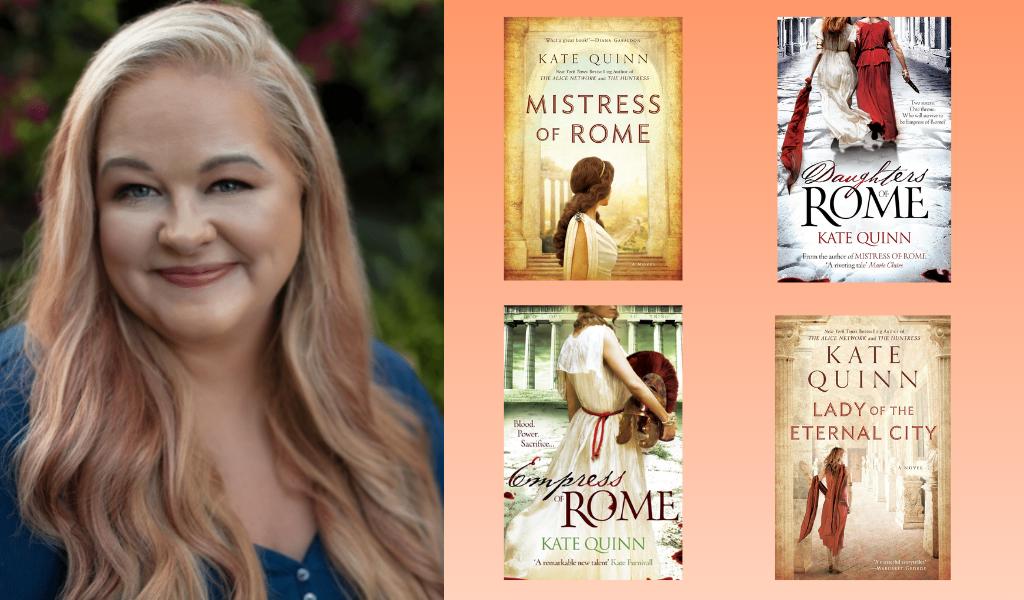

Kate Quinn is one of the most versatile and accomplished historical fiction authors writing today, seamlessly moving from the political intrigue of Ancient Rome to the battlefields of World War II with equal mastery. With multiple New York Times bestsellers and a devoted international following, Quinn has built her reputation on bringing to life the extraordinary women history nearly forgot: female spies, Soviet snipers, codebreakers, and gladiator-era survivors who changed the course of history.
Whether you’re drawn to the brutal grandeur of Imperial Rome, the shadowy world of Renaissance Italy, or the courage of women in wartime, Kate Quinn delivers meticulously researched historical fiction that reads like an addictive thriller. Her 18 published novels span two millennia of history, each one illuminating the lives of women who refused to be confined by their era’s expectations.
Disclosure: This article contains affiliate links. We earn from qualifying purchases at no extra cost to you.About Kate Quinn
Early Life and Background
Kate Quinn was born and raised in Southern California, where her love of history began at an early age. Her mother, a history scholar, shaped Quinn’s fascination with the past by telling her bedtime stories not about fairy tales, but about Julius Caesar and Alexander the Great. These early encounters with historical figures planted the seeds for what would become a remarkable writing career.
Quinn attended Boston University, where she pursued an unusual path for a future novelist. She earned both her Bachelor’s degree (2004) and Master’s degree (2006) in Classical Voice, training as an opera singer. This background in performance and dramatic storytelling would later inform her ability to create vivid, emotionally resonant historical narratives. Remarkably, Quinn began writing her first novel, Mistress of Rome, while still at Boston University, working on it alongside her demanding vocal studies.
Writing Career
Quinn’s debut novel, Mistress of Rome, was published in 2010 and introduced readers to her signature style: immersive historical detail, complex female protagonists, and plots that blend political intrigue with personal drama. The book launched her Empress of Rome Saga, a four-novel series (plus a novella) set in Imperial Rome, which would establish her as a significant voice in ancient historical fiction.
After completing her Roman saga and writing two novels about the infamous Borgia family during the Italian Renaissance, Quinn made a dramatic shift to 20th-century settings with The Alice Network in 2017. This World War I spy thriller became a breakthrough bestseller, debuting on the New York Times bestseller list and earning a spot on NPR’s “Books We Loved” list. The success of The Alice Network marked Quinn’s transition from respected historical fiction author to major commercial force.
Since then, Quinn has delivered a string of bestsellers focusing on women’s roles in World War I, World War II, and the post-war era. The Huntress (2019), The Rose Code (2021), The Diamond Eye (2022), and The Briar Club (2024) have all achieved critical and commercial success, with multiple New York Times bestseller placements. Her most recent release, The Briar Club, set during the McCarthy era, landed on NPR’s “Books We Loved” list for 2024.
Quinn currently lives in Maryland with her husband and their rescue dogs. She continues to write at a steady pace, maintaining her commitment to exhaustive historical research while delivering page-turning narratives. Her next release, The Astral Library, marks a departure into magical realism and is scheduled for February 2026.
Writing Style and Approach
What sets Kate Quinn apart is her ability to make history feel immediate and visceral. Her background in classical voice performance translates into a keen ear for dialogue and pacing. She frequently employs dual timelines, weaving together past and present storylines that converge in unexpected ways, as seen in The Alice Network and The Huntress.
Quinn’s research is exhaustive. She immerses herself in primary sources, consults with historians, and visits locations when possible. This dedication is evident in her ability to recreate not just the events of an era, but its textures: the taste of Roman wine, the sound of Bletchley Park’s codebreaking machines, and the terror of being a female sniper on the Eastern Front.
Her novels consistently spotlight women in roles that challenge historical stereotypes. Rather than focusing on queens and empresses (though she writes those too), Quinn seeks out the female spies, soldiers, gladiator slaves, and resistance fighters whose stories were forgotten or deliberately erased. She brings them back to life with dignity, complexity, and unflinching honesty about the constraints and dangers they faced.
Readers consistently praise Quinn’s ability to balance historical authenticity with emotional accessibility. Her protagonists are flawed, fierce, and fully human. Whether writing about ancient Rome or 1940s London, she creates characters readers genuinely care about, making the stakes of historical events feel personal and urgent.
Kate Quinn Series in Reading Order
The Empress of Rome Saga
Setting: Ancient Rome, 1st-2nd century AD
Number of Books: 5 books (4 novels + 1 novella), COMPLETE
Time Span: Covers approximately 80 years of Roman history
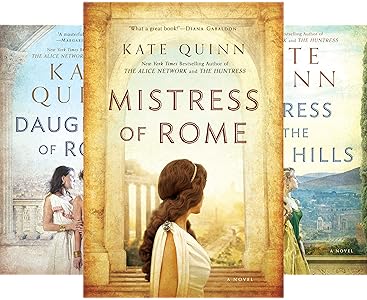
The Empress of Rome Saga is Kate Quinn’s epic exploration of Imperial Rome at its most powerful and most corrupt. Spanning from the tyrannical reign of Emperor Domitian through the enlightened rule of Emperor Hadrian, the series follows multiple generations of characters whose lives intersect across decades of political upheaval, warfare, and personal drama.
What makes this series exceptional is Quinn’s commitment to showing Rome from perspectives rarely explored in historical fiction: slaves, gladiators, singers, and women navigating the dangerous waters of imperial power. The series balances sweeping historical events with intimate character studies, creating a rich tapestry of Roman life that feels authentic and deeply human.
Reading Order:
- Mistress of Rome (2010)
Setting: Emperor Domitian’s reign (81-96 AD)
Quinn’s debut novel introduces Thea, a Jewish slave girl purchased as a companion for the spoiled Roman heiress Lepida Pollia. When both women fall for the same gladiator, the legendary fighter known as the Barbarian, their rivalry sets in motion a chain of events involving slavery, survival, and the deadly attention of the sadistic Emperor Domitian. Thea reinvents herself as Athena, a celebrated singer, but discovers that fame brings its own dangers when the emperor decides he wants her for himself. The novel showcases Quinn’s talent for crafting compelling female characters who overcome seemingly insurmountable circumstances through intelligence and determination.
- Daughters of Rome (2011)
Setting: The Year of the Four Emperors (69 AD)
Set during one of Rome’s most chaotic periods, this novel follows four Roman women from a noble family as they navigate the tumultuous year when four different men claimed the imperial throne. Cornelia, the perfect Roman wife, expects to become empress. Her sister Marcella discovers unexpected talents for political manipulation. Their cousins, headstrong Lollia and sharp-tongued Diana, find themselves swept up in events beyond their control. As civil war tears Rome apart, these women must decide where their loyalties lie and what they’re willing to sacrifice for power, love, and survival.
- Empress of the Seven Hills (2012)
Setting: Trajan’s reign, early 2nd century AD
The third novel brings back beloved characters from Mistress of Rome, now decades older and facing new challenges. Vix, raised as a gladiator’s son, has returned to Rome to make his fortune as a soldier. Sabina, future empress, navigates the deadly politics of the imperial court. As Rome expands its borders under the warrior emperor Trajan, personal ambitions and loyalties are tested on battlefields from Britain to the Middle East. Quinn expertly blends military history with court intrigue, showing how Rome’s conquests shaped the lives of both emperors and commoners.
- The Three Fates (2015)
Format: Novella (Book 3.5)
This shorter work bridges the gap between Empress of the Seven Hills and Lady of the Eternal City, offering glimpses into the lives of key characters during the transitional years. While not essential to the main series arc, it provides satisfying closure to some storylines and sets the stage for the final novel.
- Lady of the Eternal City (2015)
Setting: Emperor Hadrian’s reign (117-138 AD)
The saga concludes during the reign of Hadrian, one of Rome’s most complex emperors. Sabina has become empress, but her marriage to Hadrian is loveless and fraught with danger. The aging warrior Vix finds himself caught between loyalty to the emperor and his enduring love for Sabina. As Hadrian builds his wall in Britain and his villa at Tivoli, his personal and political lives collide in devastating ways, as he elevates his beloved Antinous and mourns his death. Quinn brings her Roman saga to a powerful close, examining the price of power and the endurance of love across decades.
Perfect for readers who love: Political intrigue, complex female protagonists, gladiators and ancient warfare, multi-generational sagas, richly detailed historical settings.
The Borgias Novels
Setting: Italian Renaissance, early 16th century
Number of Books: 2 books, COMPLETE
Focus: The infamous Borgia family
Before pivoting to 20th-century settings, Quinn wrote two novels about the Borgias, the Renaissance family whose name became synonymous with corruption, ambition, and scandal. These books delve into the early years of the Borgia dynasty, when Rodrigo Borgia (later Pope Alexander VI) maneuvered his way to the papacy, while his children, including the notorious Lucrezia and Cesare, carved their own paths to power.
Quinn brings her signature focus on women’s perspectives to this male-dominated world, illuminating the lives of the women who loved, served, and survived the Borgias.
Reading Order:
- The Serpent and the Pearl (2013)
Setting: Rome, early 1490s
The first Borgia novel introduces readers to three women whose lives become entangled with the ambitious Borgia family. Giulia Farnese, a breathtakingly beautiful young woman, becomes the mistress of Cardinal Rodrigo Borgia. Leonello, a dwarf with a sharp wit and sharper knives, serves as bodyguard. Carmelina, a gifted cook, finds employment in the Borgia household. As Rodrigo schemes his way toward the papacy, these three witnesses see firsthand the corruption and brilliance of Renaissance Rome’s most dangerous family.
- The Lion and the Rose (2014)
Setting: Rome and Italy, mid-1490s to early 1500s
The conclusion follows Lucrezia Borgia, perhaps history’s most maligned woman, as she navigates the treacherous world her father and brother have created. Quinn challenges the traditional portrayal of Lucrezia as a poisoner and seductress, instead presenting her as a political pawn seeking agency in a world dominated by ruthless men. The novel continues the stories of Giulia, Leonello, and Carmelina as Pope Alexander VI’s reign reaches its zenith and the Borgia family’s grip on power begins to slip.
Perfect for readers who love: Renaissance Italy, papal intrigue, challenging historical stereotypes, court politics, and morally complex characters.
Standalone Novels by Kate Quinn
While Quinn has written series, her most commercially successful and critically acclaimed works have been standalone novels set in the 20th century. These books, all published since 2017, have established her as one of the premier voices in World War II historical fiction, introducing her to a much broader readership.
20th Century World War Novels
The Alice Network (2017)
Setting: France during WWI (1915) and post-WWII (1947)
Quinn’s breakthrough novel weaves together two timelines and two unforgettable heroines. In 1947, pregnant college student Charlie St. Clair travels to Europe searching for her missing cousin Rose, who disappeared in Nazi-occupied France. Her search leads her to Eve Gardiner, a bitter, reclusive former spy who worked for the real-life Alice Network, a group of female spies in German-occupied France during World War I. As the two women team up to uncover the truth about Rose’s fate, Eve’s story gradually emerges: her recruitment as a young woman to work undercover as a restaurant server, spying on German officers while risking execution as a traitor.
The novel draws on the true story of Louise de Bettignies and the Alice Network that operated during the First World War, bringing to light a piece of history largely forgotten. Quinn’s dual-timeline structure allows her to build suspense while exploring themes of courage, betrayal, and redemption across generations.
New York Times Bestseller | NPR “Books We Loved” Selection
The Huntress (2019)
Setting: WWII Eastern Front and post-war America (1946-1950)
Three very different people unite in the hunt for a Nazi war criminal in this propulsive thriller. Ian Graham, a British journalist haunted by his wartime experiences, has spent years tracking Nazi fugitives. Nina Markova, a former Soviet bomber pilot with the legendary Night Witches regiment, seeks personal vengeance against a female war criminal known as the Huntress. Jordan McBride, a seventeen-year-old aspiring photographer in Boston, begins to suspect that her father’s new German bride is not who she claims to be.
As their stories converge, Quinn alternates between Nina’s harrowing experiences as a Night Bomber during the war, Ian’s post-war Nazi-hunting operations, and Jordan’s growing certainty that her stepmother is the Huntress herself. The novel showcases Quinn’s ability to create distinct narrative voices and build tension across multiple storylines, while also highlighting the extraordinary women who flew combat missions for the Soviet Union.
New York Times Bestseller
The Rose Code (2021)
Setting: Bletchley Park, England (1940-1947)
Quinn turns her attention to the secret world of Bletchley Park, where British codebreakers worked to crack German encryptions during World War II. The novel follows three very different women recruited to work at the mysterious estate: Osla Kendall, a beautiful debutante with a sharp mind; Mab Churt, a working-class Londoner determined to rise above her station; and Beth Finch, a shy spinster with an extraordinary gift for solving puzzles.
As they work to break codes that could change the course of the war, the three women form a deep friendship. But in 1947, Beth is confined to a mental asylum, convinced she has discovered a traitor at Bletchley Park. With the royal wedding approaching and a potential threat to the royal family, Osla and Mab must reunite to solve one final code and prove Beth’s sanity. Quinn brilliantly captures the pressure-cooker atmosphere of Bletchley Park and the official silencing that codebreakers endured for decades after the war.
New York Times Bestseller
The Diamond Eye (2022)
Setting: Ukraine and the Eastern Front (1937-1944)
Based on the true story of Lyudmila Pavlichenko, this novel tells the extraordinary tale of a history student and mother who became the Soviet Union’s most successful female sniper, credited with 309 confirmed kills. Quinn follows Mila from her quiet life at Kiev University, raising her young son, through her transformation into “Lady Death,” the sniper who struck terror into German forces during the siege of Sevastopol.
The novel doesn’t shy away from the brutality of the Eastern Front or the propaganda purposes to which Mila was put. When she traveled to America on a publicity tour, she met Eleanor Roosevelt and captivated American audiences with her plain-spoken accounts of warfare. Quinn explores Mila’s internal struggle between her duties as a soldier, her identity as a mother, and her desire to reclaim her life after the war.
New York Times Bestseller
The Briar Club (2024)
Setting: Washington, D.C., McCarthy era (1950-1956)
Quinn’s most recent novel shifts from World War II to its aftermath, exploring the paranoia and persecution of the McCarthy era through the lens of women living in a Washington D.C. boardinghouse. When a body is discovered in Briarwood House on Thanksgiving 1956, the women who live there become suspects in a murder investigation. As their secrets emerge, the novel flashes back to reveal how these very different women came to live under one roof and what bonds and betrayals connect them.
The Briar Club examines Cold War paranoia, the persecution of homosexuals during the Lavender Scare, racial tensions, and the constricting social expectations placed on women in the 1950s. Quinn weaves a murder mystery with a powerful exploration of female friendship and the courage required to live authentically in repressive times.
NPR “Books We Loved” 2024
Collaborative Novels
Kate Quinn has participated in six collaborative projects, working with other historical fiction authors to create interconnected novellas set during pivotal historical moments. These collections showcase Quinn’s versatility and her ability to work within shared universes alongside other talented writers.
A Day of Fire: A Novel of Pompeii (2014)
Co-authors: Stephanie Dray, Sophie Perinot, Ben Kane, E. Knight, Vicky Alvear Shecter
Six interlinked novellas chronicle the last day of Pompeii in 79 AD, from the perspectives of citizens who died and those who escaped the catastrophic eruption of Mount Vesuvius. Quinn’s contribution fits seamlessly into her Roman expertise, offering another lens into ancient Roman life at its most dramatic moment.
A Year of Ravens: A Novel of Boudica’s Rebellion (2015)
Co-authors: Ruth Downie, Stephanie Dray, E. Knight, Vicky Alvear Shecter, S.J.A. Turney, Russell Whitfield
Seven authors tell the story of Boudica’s rebellion against Roman rule in Britain, exploring the clash between Celtic culture and Roman imperialism through multiple perspectives. This project allowed Quinn to explore Roman Britain, expanding her geographic scope beyond Rome itself.
A Song of War (2016)
Co-authors: David Blixt, Libbie Hawker, Russell Whitfield, S.J.A. Turney, Stephanie Thornton, Vicky Alvear Shecter
The Trojan War comes to life through multiple viewpoints, from Helen to Hector, from priests to warriors. Quinn contributed to this mythological epic, demonstrating her range beyond strictly historical settings.
Ribbons of Scarlet (2019)
Co-authors: Stephanie Dray, Laura Kamoie, Eliza Knight, Sophie Perinot, Heather Webb
Six authors illuminate the French Revolution through the stories of six women whose paths crossed during this tumultuous period, from princesses to peasants, from fanatics to philosophers. Quinn’s contribution showcases her ability to handle revolutionary politics and the extraordinary women who shaped them.
The Phoenix Crown (2023)
Co-author: Janie Chang
Quinn’s first two-author collaboration tells a dual-timeline story involving the Metropolitan Opera, stolen Chinese antiquities, and the 1906 San Francisco earthquake. Soprano Gemma Garland’s career becomes entangled with dangerous secrets and valuable artifacts, leading to a thrilling convergence of art, crime, and disaster.
NPR “Books We Loved” 2024
Where to Start with Kate Quinn
Best First Book
Recommendation: The Alice Network
If you’re new to Kate Quinn, The Alice Network is the perfect entry point. It’s the book that brought her mainstream success for good reason: it combines dual timelines, compelling heroines, real historical events (the Alice Network really existed), and page-turning suspense. The novel showcases all of Quinn’s strengths: meticulous research, complex female characters, and emotional depth, while being completely accessible to readers unfamiliar with her earlier work.
The dual timeline structure makes it easy to follow, the World War I setting feels fresh compared to the oversaturated WWII market (though Quinn excels there, too), and the mystery element keeps you turning pages. Most importantly, no prior knowledge is required. It stands alone beautifully while demonstrating exactly why Quinn has become one of historical fiction’s biggest names.
If You Want…
Ancient Rome and gladiators: Start with Mistress of Rome
Quinn’s debut novel immerses you in Imperial Rome at its most decadent and dangerous. If you love the political intrigue of I, Claudius or the action of Spartacus, this is your entry point. The Empress of Rome Saga can then be read in order for a multi-generational epic.
WWII female fighters: Start with The Huntress
For readers fascinated by the Soviet Night Witches, female pilots, and post-war Nazi hunting, The Huntress delivers on all fronts. Nina Markova is one of Quinn’s most memorable protagonists, and the novel skillfully balances wartime action with post-war thriller elements.
Bletchley Park codebreakers: Start with The Rose Code
If you loved The Imitation Game or are fascinated by cryptography and British intelligence, The Rose Code offers a deep dive into Bletchley Park through the eyes of three very different women. Quinn’s research shines here, capturing both the intellectual challenges and the social dynamics of this secret world.
True story of a real woman: Start with The Diamond Eye
Based on the real-life Soviet sniper Lyudmila Pavlichenko, this novel offers both a gripping war story and a meditation on what it means to be turned into a symbol. Quinn handles the true story with respect while making it deeply personal and emotionally resonant.
Renaissance intrigue: Start with The Serpent and the Pearl
The Borgias novels showcase Quinn’s range. If you prefer Renaissance Italy to ancient Rome or modern wars, these books deliver papal politics, court intrigue, and Quinn’s signature focus on strong women navigating dangerous male-dominated worlds.
Literary and recent: Start with The Briar Club
Quinn’s most recent novel (2024) is also one of her most ambitious, tackling McCarthy-era paranoia, the Lavender Scare, and Cold War tensions through a murder mystery framework. It’s a mature and nuanced work that showcases Quinn at the height of her powers.
Books by Time Period
Kate Quinn’s versatility is one of her defining characteristics. Unlike many historical fiction authors who specialize in a single era, Quinn has mastered multiple time periods across two millennia.
Ancient Rome (1st-2nd Century AD)
- Mistress of Rome
- Daughters of Rome
- Empress of the Seven Hills
- The Three Fates
- Lady of the Eternal City
- A Day of Fire (collaborative, Pompeii 79 AD)
- A Year of Ravens (collaborative, Boudica’s rebellion)
Explore more books about Ancient Rome
Ancient World (Mythological Era)
- A Song of War (collaborative, Trojan War)
Italian Renaissance (15th-16th Century)
- The Serpent and the Pearl
- The Lion and the Rose
World War I (1914-1918)
- The Alice Network (partially set in WWI)
World War II (1939-1945)
- The Alice Network (partially set post-WWII)
- The Huntress
- The Rose Code
- The Diamond Eye
Explore more WWII Historical Fiction
Revolutionary Era
- Ribbons of Scarlet (collaborative, French Revolution)
Post-War/Cold War Era (1946-1950s)
- The Briar Club (McCarthy era)
- The Huntress (partially post-war)
Modern/Magical Realism
- The Phoenix Crown (collaborative, 1906 San Francisco)
- The Astral Library (upcoming 2026, contemporary fantasy)
Popular Kate Quinn Books
The Alice Network (2017): Quinn’s Breakthrough
The Alice Network represents a turning point in Kate Quinn’s career. After building a respectable following with her Roman and Renaissance novels, this World War I spy thriller catapulted her into the mainstream, becoming a New York Times bestseller and earning widespread critical acclaim.
What makes the novel special is its dual-timeline structure, which Quinn would refine in subsequent books. In 1947, Charlie St. Clair is pregnant, unmarried, and searching for her cousin Rose, who disappeared during the war. Her journey leads her to Eve Gardiner, a scarred, alcoholic former spy who once worked for the Alice Network, a real group of female spies operating behind German lines in occupied France during World War I.
The alternating chapters build suspense masterfully. As Charlie and Eve road-trip through Europe following cold leads, readers learn about young Eve’s recruitment and training, her dangerous work gathering intelligence in a restaurant frequented by German officers, and the betrayal that destroyed the network. The personal stakes are high: Eve seeks revenge against the man who betrayed her, while Charlie needs to know if Rose is alive.
Quinn based the Alice Network on historical facts. The real network, run by Louise de Bettignies (called “Alice” by British intelligence), operated successfully for years before being compromised. Quinn conducted extensive research into World War I espionage, the treatment of women accused of collaboration, and the post-war reckoning with traitors and heroes alike.
The novel resonates because it rescues forgotten history. World War I spy networks, especially those run by women, have been overshadowed by World War II narratives. Quinn brings these brave women back into the light, showing the courage required to spy on occupying forces and the terrible prices paid for failure.
Perfect for readers who love: Dual timelines, female spies, World War I settings, road trip narratives, stories of redemption, and historical mysteries.
The Huntress (2019): Night Witches and Nazi Hunters
Following the success of The Alice Network, Quinn delivered another bestseller with The Huntress, a propulsive thriller that alternates between three protagonists across two timelines. Nina Markova, a Soviet bomber pilot with the Night Witches regiment, witnessed a horrific war crime committed by a female Nazi administrator known only as the Huntress. Years after the war, Nina teams up with Ian Graham, a British journalist turned Nazi hunter, to track down this woman who has disappeared into post-war chaos.
Meanwhile, in 1950 Boston, seventeen-year-old Jordan McBride notices disturbing inconsistencies in her father’s new German bride. As Jordan investigates, she begins to suspect her stepmother might be the Huntress herself, now living under an assumed identity in America.
Quinn’s research into the Soviet Night Witches, an all-female bomber regiment that flew dangerous night missions against German forces, brings to life one of World War II’s most extraordinary military units. These women flew obsolete biplanes on harassment bombing runs, earning both the respect of Soviet commanders and the fear of German troops who nicknamed them “Night Witches” for the whooshing sound their planes made.
Nina’s character embodies the contradictions these women faced: celebrated as heroes while fighting, marginalized after the war, and traumatized by experiences few could understand. Her partnership with Ian, who carries his own war wounds, creates a compelling dynamic as they pursue justice across continents.
The novel succeeds as both historical fiction and thriller. Quinn builds genuine suspense about whether the Huntress will be caught and what will happen to Jordan if her suspicions are correct. The moral questions are complex: What justice is possible years after the crime has been committed? How do survivors rebuild after witnessing atrocities? Can forgiveness ever coexist with accountability?
Perfect for readers who love: Female fighter pilots, Nazi hunters, post-war thrillers, multiple POV narratives, Boston setting, moral complexity, suspenseful pacing.
The Rose Code (2021): Bletchley Park Codebreakers
Quinn’s exploration of Bletchley Park, the secret British facility where codebreakers cracked German encryptions during World War II, demonstrates her ability to make intellectual work thrilling. The Rose Code follows three women recruited to work at Bletchley: Osla Kendall, a society beauty with brains to match; Mab Churt, a working-class and ambitious woman; and Beth Finch, a shy spinster with extraordinary pattern-recognition abilities.
The novel opens in 1947 with Beth confined to a mental asylum, convinced she uncovered a traitor at Bletchley Park during the war. When a coded message threatens the upcoming royal wedding, Osla and Mab must reunite to solve the puzzle and clear their friend’s name. The bulk of the novel then flashes back to show how these three very different women met, formed an unlikely friendship, and worked on some of the war’s most crucial codebreaking efforts.
Quinn captures the unique atmosphere of Bletchley Park: the intellectual excitement, the crushing pressure, the eccentric personalities, and the absolute secrecy that prevented workers from discussing their jobs for decades after the war. She also explores the gender dynamics; women were essential to Bletchley’s success, but often relegated to support roles while men received credit for breakthroughs.
Each of the three protagonists represents a different type of woman working at Bletchley. Osla, based loosely on Osla Benning (who dated Prince Philip), navigates high society while doing serious intellectual work. Mab fights class prejudice and seeks social mobility through her work. Beth, the most talented codebreaker, must overcome crippling shyness and family pressure to contribute her gifts.
The friendship between these women forms the emotional core of the novel. Quinn shows how shared purpose and mutual respect can bridge social divides, but also how secrets and jealousies can poison even the strongest bonds. The mystery element: who betrayed Beth? Is there really a traitor? Keeps pages turning while the historical detail satisfies readers fascinated by cryptography and World War II intelligence work.
Perfect for readers who love: Bletchley Park, codebreaking, female friendship, British settings, dual timelines, mystery elements, overlooked women in WWII.
The Diamond Eye (2022): Soviet Sniper
With The Diamond Eye, Quinn tackles one of World War II’s most remarkable true stories: Lyudmila Pavlichenko, the Soviet sniper who became one of history’s most successful female combat soldiers with 309 confirmed kills. The novel follows Mila (as Quinn calls her) from her ordinary life as a history student and single mother in Kiev through her transformation into “Lady Death,” the sniper who terrorized German forces during the siege of Sevastopol.
Quinn’s research is evident in every detail, from the mechanics of sniper training to the horrific conditions of the Eastern Front. She doesn’t romanticize warfare or Mila’s killing. Instead, she explores the psychological toll of war, the dehumanization necessary to function as a sniper, and the impossible position Mila occupied as both a symbol of Soviet female empowerment and a propaganda tool.
The novel’s second half chronicles Mila’s 1942 publicity tour in America, where she met Eleanor Roosevelt and spoke to packed audiences about the Soviet war effort. Quinn imagines a deep friendship between Mila and Eleanor, exploring how these two very different women found common ground in their determination to make meaningful contributions to the war effort, despite the limitations society placed on women.
What makes the novel powerful is Quinn’s refusal to simplify Mila’s story. Yes, she was an extraordinary soldier who killed hundreds of enemy troops. She was also a mother desperate to return to her son, a woman exploited by Soviet propaganda, a traumatized veteran struggling with PTSD, and a human being trying to reclaim her identity after being turned into a symbol. Quinn honors the real Lyudmila Pavlichenko by portraying her as fully human, rather than as a one-dimensional war hero.
Perfect for readers who love: True stories, female soldiers, Soviet history, Eleanor Roosevelt, sniper warfare, psychological depth, Eastern Front narratives.
The Briar Club (2024): McCarthy Era Mystery
Quinn’s most recent novel represents her most contemporary setting yet, although it remains firmly rooted in history. Set in a Washington D.C. boardinghouse during the McCarthy era (1950-1956), The Briar Club opens with a body discovered on Thanksgiving 1956, then flashes back to reveal how six very different women came to live at Briarwood House and what secrets connect them.
The novel tackles some of the darkest aspects of 1950s America: the Red Scare, the Lavender Scare (persecution of homosexuals), racial segregation, and the suffocating social expectations placed on women. Each woman living at Briarwood House carries secrets that could destroy her if exposed. As a murder investigation unfolds, those secrets emerge, threatening not just individual lives but the bonds of trust and friendship the women have built.
Quinn uses the mystery framework to explore serious historical themes. The paranoia of the McCarthy era, when neighbors informed on neighbors and lives were ruined by unsubstantiated accusations, creates an atmosphere of constant threat. The Lavender Scare, less well-known than the Red Scare, targeted gay and lesbian Americans who worked for the government, destroying careers and lives based on sexual orientation.
The novel also examines female friendship across racial and class lines. The women of Briarwood House come from diverse backgrounds and possess varying privileges, but their shared vulnerability as women in a repressive society fosters unexpected alliances. Quinn shows how women supported each other in an era when legal and social structures offered little protection against abuse, discrimination, or poverty.
The Briar Club demonstrates Quinn’s growth as a novelist. The prose is more literary, the themes more complex, the historical analysis more nuanced than in her earlier works. It’s a mature examination of an often-idealized decade that reveals the courage required simply to live authentically.
Perfect for readers who love: 1950s settings, McCarthy era, LGBTQ+ history, murder mysteries, female friendship, Washington D.C., and challenging nostalgia for the “good old days.”
Awards and Recognition
Kate Quinn’s work has garnered significant critical and commercial acclaim, establishing her as one of the most successful contemporary authors in historical fiction.
New York Times Bestsellers:
- The Alice Network (2017)
- The Huntress (2019)
- The Rose Code (2021)
- The Diamond Eye (2022)
USA Today Bestseller:
- Multiple titles across her career
NPR “Books We Loved” Selections:
- The Alice Network (2017)
- The Phoenix Crown (2024, collaborative with Janie Chang)
- The Briar Club (2024)
Critical Praise:
- Featured in The Washington Post
- Positive reviews in Kirkus Reviews
- Starred reviews from Booklist
- Endorsements from bestselling authors, including Diana Gabaldon, Kristin Hannah, and Stephanie Dray
International Success:
- Books translated into multiple languages
- Strong international sales, particularly in the UK and Commonwealth markets
Media Coverage:
- Regular features in book industry publications
- Author interviews in major media outlets
- Strong social media presence with an engaged reader community
While Quinn hasn’t won major literary awards, such as the Booker Prize, her consistent commercial success and critical recognition have established her as a significant force in historical fiction. Her ability to combine meticulous research with page-turning narratives has earned her respect from both historians and general readers.
Writing Schedule and Upcoming Books
Latest Release
The Briar Club (2024)
Quinn’s most recent novel was released in 2024 and immediately earned a spot on NPR’s “Books We Loved” list. The McCarthy-era mystery set in a Washington D.C. boardinghouse represents some of Quinn’s most mature and nuanced writing, tackling difficult themes with sensitivity and historical rigor.
Upcoming Releases
The Astral Library (February 17, 2026)
Quinn’s next release marks a significant departure from her usual historical fiction. The Astral Library is her first foray into magical realism, though it maintains her focus on books, libraries, and the power of storytelling.
The novel follows Alexandria “Alix” Watson, a young woman who has cycled through foster care and now works three dead-end jobs to survive. Her refuge is the Boston Public Library’s reading room, where she escapes into fantasy novels. When she discovers a hidden door leading to the Astral Library, she meets the Librarian, an ageless guardian of a magical library where desperate people can literally enter their favorite books and live new lives within their pages.
But when a shadowy enemy threatens the Astral Library, Alix and the Librarian must flee through the worlds of Jane Austen, Sherlock Holmes, and The Great Gatsby, racing to discover who wants to destroy the Library and why. Quinn describes the book as her “love letter to libraries, librarians, and readers everywhere.”
This departure into magical realism is a bold move for an author known for meticulous historical research, but Quinn’s background in creating immersive worlds suggests she’s well-equipped for the challenge. Fans curious about this new direction can pre-order the book now, with special deluxe editions featuring stenciled edges and illustrated endpapers available.
Publishing Pace
Quinn has maintained a remarkably consistent publishing schedule since her breakthrough with The Alice Network:
- 2017: The Alice Network
- 2019: The Huntress, Ribbons of Scarlet (collaborative)
- 2021: The Rose Code
- 2022: The Diamond Eye
- 2023: The Phoenix Crown (collaborative with Janie Chang)
- 2024: The Briar Club
- 2026: The Astral Library (upcoming)
This pace of roughly one book every 1-2 years allows Quinn to maintain the extensive research her novels require while meeting reader demand for new work. She has mentioned in interviews that research often takes as long as writing, particularly for her 20th-century novels, where she consults with historians and seeks out primary sources.
Future Projects
Quinn has not announced specific projects beyond The Astral Library, but she has mentioned in interviews that she may return to collaborative projects and that she continues to explore different historical periods. Given her track record of tackling new eras and expanding her range, readers can anticipate more surprises in her future work.
Similar Authors You’ll Enjoy
If you love Kate Quinn’s work, these authors offer a similar appeal:
Kristin Hannah – Like Quinn, Hannah excels at WWII fiction featuring strong female protagonists. The Nightingale and The Four Winds showcase her talent for emotionally driven, character-rich historical fiction, informed by meticulous research.
Pam Jenoff – Another WWII specialist, Jenoff writes about female resistance fighters, spies, and survivors. Her novels, The Lost Girls of Paris and The Orphan’s Tale, will appeal to fans of Quinn.
Martha Hall Kelly – Kelly’s Lilac Girls trilogy explores World War II from female perspectives, including those of a French resistance fighter, a Polish teenager at Ravensbrück, and an American philanthropist. Her research is as thorough as Quinn’s.
Philippa Gregory – For readers who enjoyed Quinn’s Roman and Renaissance novels, Gregory’s extensive Tudor and Plantagenet series offer a similar blend of political intrigue and strong female characters navigating perilous courts.
Hilary Mantel – Readers who appreciate Quinn’s literary ambitions should explore Mantel’s Wolf Hall trilogy, which brings a similar historical rigor to Tudor England, complemented by more literary prose.
Ariel Lawhon – Lawhon specializes in novels about real historical women whose stories deserve wider recognition, similar to Quinn’s approach with Lyudmila Pavlichenko and the Alice Network.
Stephanie Dray – A frequent collaborator with Quinn, Dray writes about powerful women in history, from Cleopatra’s daughter to America’s founding mothers. Her research matches Quinn’s thoroughness.
Lauren Willig – For readers who enjoy Quinn’s dual timeline structure, Willig’s novels often alternate between modern-day researchers and historical figures, particularly in her Pink Carnation series.
Frequently Asked Questions
How many books has Kate Quinn written?
Kate Quinn has written 18 published books as of 2024, with one additional book scheduled for release in February 2026. This includes 5 books in the Empress of Rome Saga (4 novels plus 1 novella), 2 Borgia novels, 5 standalone 20th-century novels, and 6 collaborative works written with other historical fiction authors. Her upcoming book, The Astral Library, will be her 19th publication.
What is Kate Quinn’s best book?
The “best” Kate Quinn book is subjective and depends on your interests, but The Alice Network is generally considered her breakthrough masterpiece and the most accessible entry point for new readers. It became a New York Times bestseller and an NPR “Books We Loved” selection, introducing her to a mainstream audience. However, many readers consider The Rose Code (a story about Bletchley Park codebreakers) or The Diamond Eye (a true story about a Soviet sniper) to be her finest achievements. If you prefer ancient settings, Mistress of Rome showcases her talent in a different era. Her most recent work, The Briar Club, represents her most mature writing.
In what order should I read Kate Quinn’s books?
Kate Quinn’s books can be read in any order, as most are standalone novels. However, here are the reading order recommendations:
For the Empress of Rome Saga (must read in order):
- Mistress of Rome
- Daughters of Rome
- Empress of the Seven Hills
- The Three Fates (novella)
- Lady of the Eternal City
For the Borgias (read in order):
- The Serpent and the Pearl
- The Lion and the Rose
For standalone 20th-century novels: Read in any order, though starting with The Alice Network is recommended as it showcases Quinn’s signature style and strengths.
For new readers, start with The Alice Network or The Rose Code if you prefer WWII settings, Mistress of Rome if you prefer ancient Rome, or The Briar Club if you want to read her most recent work.
Does Kate Quinn write series or standalones?
Kate Quinn writes both. She completed two series early in her career: the Empress of Rome Saga (5 books set in ancient Rome) and the Borgias novels (2 books set in Renaissance Italy). Since 2017, she has focused primarily on standalone novels set in the 20th century, including The Alice Network, The Huntress, The Rose Code, The Diamond Eye, and The Briar Club. She has also participated in six collaborative multi-author projects. Her standalones don’t share characters or storylines, so they can be read in any order.
What time periods does Kate Quinn write about?
Kate Quinn is remarkably versatile, covering over 2,000 years of history across her 18 books:
- Ancient Rome (1st-2nd century AD): Empress of Rome Saga
- Ancient World: Pompeii (79 AD), Boudica’s rebellion, Trojan War
- Italian Renaissance (15th-16th century): Borgias novels
- World War I (1914-1918): The Alice Network (partially)
- World War II (1939-1945): The Alice Network (partially), The Huntress, The Rose Code, The Diamond Eye
- Post-War/Cold War (1946-1950s): The Briar Club, The Huntress (partially)
- French Revolution: Ribbons of Scarlet (collaborative)
- 1906: The Phoenix Crown (collaborative)
Her upcoming book, The Astral Library (2026), marks a departure into contemporary magical realism.
Are Kate Quinn’s books historically accurate?
Kate Quinn is known for meticulous historical research. She consults with historians, uses primary sources when available, and visits locations when possible. Her novels blend historical facts with fictional characters and dramatized events, but the historical frameworks are accurate and well-researched. For example, the Alice Network in WWI was a real organization, Lyudmila Pavlichenko was a genuine Soviet sniper with 309 confirmed kills, and Bletchley Park codebreakers did work under the conditions Quinn describes.
Quinn takes some creative liberties for dramatic purposes, particularly in dialogue and the inner lives of historical figures, but she’s transparent about what’s historical fact versus fiction. The author’s notes at the end of her books typically explain where she deviated from known history and why. For ancient Rome novels, where documentation is incomplete, she has more creative freedom but still grounds her work in archaeological and historical evidence.
Has Kate Quinn’s work been adapted for TV or film?
As of 2024, Kate Quinn’s novels have not been adapted for television or film, though several would translate well to screen. The Alice Network, The Huntress, The Rose Code, and The Diamond Eye all possess cinematic potential, featuring strong female leads, clear narrative arcs, and visually compelling settings. Given the success of similar World War II adaptations and the continued popularity of historical dramas, it seems likely that Quinn’s work will eventually attract producers. Fans hope that adaptations will follow the success of other historical fiction brought to the screen.
What is Kate Quinn’s latest book?
Kate Quinn’s latest published book is The Briar Club (2024), a historical mystery set in a Washington D.C. boardinghouse during the McCarthy era. The novel explores female friendship, Cold War paranoia, and the Lavender Scare through the framework of a murder investigation. It received critical acclaim and was selected for NPR’s “Books We Loved” list for 2024.
Her next book, The Astral Library, is scheduled for release on February 17, 2026. This will be Quinn’s first venture into magical realism, telling the story of a young woman who discovers a magical library where books become portals to other worlds.
Is Kate Quinn still writing?
Yes, Kate Quinn is actively writing. Her most recent book, The Briar Club, was published in 2024, and her next novel, The Astral Library, is scheduled for February 2026. She maintains a steady publishing pace of roughly one book every 1-2 years, allowing time for the extensive research her novels require. She continues to engage with readers through social media, occasionally discussing future projects, although she hasn’t announced specific books beyond The Astral Library. At the height of her career and popularity, Quinn shows no signs of slowing down.
Should I read Kate Quinn’s books in order?
For her two series (Empress of Rome Saga and the Borgias novels), yes, read those in publication order as they follow continuing characters and storylines. For her standalone 20th-century novels, no order is required. Each book tells a complete story with different characters and settings. You can start with whichever book’s premise interests you most. Many readers begin with The Alice Network, as it was Quinn’s breakthrough bestseller and showcases her strengths. However, starting with The Huntress, The Rose Code, The Diamond Eye, or The Briar Club works equally well.
What is the order of Kate Quinn’s books?
Complete chronological publication order:
- Mistress of Rome (2010)
- Daughters of Rome (2011)
- Empress of the Seven Hills (2012)
- The Serpent and the Pearl (2013)
- A Day of Fire (2014, collaborative)
- The Lion and the Rose (2014)
- The Three Fates (2015)
- Lady of the Eternal City (2015)
- A Year of Ravens (2015, collaborative)
- A Song of War (2016, collaborative)
- The Alice Network (2017)
- The Huntress (2019)
- Ribbons of Scarlet (2019, collaborative)
- The Rose Code (2021)
- The Diamond Eye (2022)
- The Phoenix Crown (2023, collaborative with Janie Chang)
- The Briar Club (2024)
- The Astral Library (February 2026, upcoming)
Where does Kate Quinn live?
Kate Quinn currently lives in Maryland with her husband and their rescue dogs. She was born and raised in Southern California and attended Boston University for her education. Some older biographical materials mention San Diego, suggesting that she may have lived there at some point; however, current sources consistently place her in Maryland. Despite her travels for research, she maintains her Maryland residence as her home base for writing.
How old is Kate Quinn?
While Kate Quinn’s exact birthdate is not publicly available, biographical information indicates she graduated from Boston University with her Bachelor’s degree in 2004 and her Master’s degree in 2006, suggesting she was likely born in the early 1980s. Quinn maintains privacy about her personal life and focuses public attention on her work rather than biographical details. What matters most to readers is that she’s at the height of her creative powers, actively publishing acclaimed novels.
Kate Quinn stands as one of the most accomplished and versatile authors in historical fiction. From the blood-soaked arenas of Imperial Rome to the secret codebreaking rooms of Bletchley Park, from Renaissance papal intrigue to Soviet sniper nests on the Eastern Front, Quinn has mastered an extraordinary range of historical settings while maintaining a consistent focus: illuminating the lives of extraordinary women history nearly forgot.
Her 18 published books showcase not just historical expertise but genuine storytelling craft. Quinn understands that great historical fiction requires more than accurate research. It demands compelling characters readers care about, plots that build genuine suspense, and prose that transports readers across centuries. She delivers on all counts, which explains why her books consistently appear on bestseller lists while earning critical praise for their historical rigor.
What sets Quinn apart is her commitment to recovering women’s stories. Whether she’s writing about female spies in World War I, Soviet bomber pilots, Bletchley Park codebreakers, or enslaved women in ancient Rome, Quinn asks: Who were these women? What did they endure? What courage did it take to survive, resist, or fight in worlds that offered them few options? Her answers to these questions create powerful, emotionally resonant narratives that challenge our understanding of both history and women’s capabilities.
For readers new to Quinn’s work, the journey ahead is remarkable. Whether you choose to start with her Roman saga, her Renaissance novels, or her acclaimed 20th-century standalones, you’ll discover an author at the top of her craft, delivering meticulously researched, beautifully written, and deeply humane historical fiction that reminds us why we turn to stories about the past: to better understand both who we were and who we might become.
Ready to begin your Kate Quinn reading journey? Start with The Alice Network and discover why readers around the world have fallen in love with her unique blend of historical authenticity, compelling storytelling, and unforgettable heroines who refused to be silenced by history.