


Robert Harris is one of the most acclaimed authors of political thrillers and historical fiction of our time, known for his meticulous research, gripping narratives, and ability to make history feel urgent and contemporary. With 16 bestselling novels translated into 40 languages and nine film and television adaptations, Harris has established himself as a master storyteller whose work bridges the ancient past and modern politics.
From his breakout alternate-history thriller, Fatherland (1992), to his recent WWI political drama, Precipice (2024), Harris’s novels span Roman antiquity, World War II, Cold War intrigue, and contemporary thrillers. His Cicero Trilogy stands as one of the great achievements in historical fiction, while his standalone novels, such as Conclave and Munich, demonstrate his versatility across genres and time periods.
Harris’s background as a BBC political journalist informs every novel he writes, bringing insider knowledge of power structures, media manipulation, and political intrigue. Whether dramatizing ancient Rome’s power struggles or exploring alternate Nazi histories, his books ask timeless questions about democracy, ambition, corruption, and the fragile nature of civilization.
📚 Disclosure: This article contains affiliate links. We earn from qualifying purchases at no extra cost to you.
About Robert Harris
Early Life and Background
Robert Dennis Harris was born on March 7, 1957, in Nottingham, England. He grew up in a small rented house on a council estate, where his father worked at a local printing plant. Visits to his father’s workplace sparked his early fascination with the written word and printing process. Harris attended Belvoir High School in Bottesford, Leicestershire, and later King Edward VII School in Melton Mowbray, where a hall was eventually named in his honor.
Harris studied at Selwyn College, Cambridge University, where he developed the intellectual foundation that would later inform his historically rigorous fiction. His literary heroes include Graham Greene, George Orwell, and Evelyn Waugh, writers known for political engagement and moral complexity.
Journalism Career
Before becoming a novelist, Harris established himself as one of Britain’s most respected political journalists. He worked as a reporter for the BBC’s prestigious Newsnight and Panorama programs, gaining firsthand experience of political maneuvering and media dynamics. At age 30, he became Political Editor of The Observer, one of Britain’s leading newspapers.
He later wrote columns for The Sunday Times and The Daily Telegraph, cementing his reputation as a sharp political commentator. This journalism background proved invaluable to his fiction, providing an insider understanding of how power operates, how politicians think, and how the media shapes public perception.
Transition to Fiction
Harris began writing nonfiction books in the early 1980s, including A Higher Form of Killing (1982, co-authored with Jeremy Paxman), which examined chemical and biological warfare, and Selling Hitler (1986), an investigation into the Hitler Diaries scandal.
His transition to fiction came in 1992 with Fatherland, an alternate-history thriller set in a world where Nazi Germany won World War II. The novel became an international bestseller, selling over three million copies and enabling Harris to become a full-time novelist. He jokingly refers to his Berkshire home as “the house that Hitler built” because the proceeds from Fatherland allowed him to purchase it.
Writing Career and Evolution
Since Fatherland, Harris has published 16 novels, moving from World War II subjects to ancient Rome and back to contemporary political thrillers. His work demonstrates remarkable range while maintaining consistent quality and intelligence.
The Cicero Trilogy (2006-2015) represents a decade-long commitment to ancient Roman history, following the statesman Cicero through the final years of the Roman Republic. These books showcase Harris’s ability to make ancient politics feel urgently relevant to modern readers, drawing parallels to contemporary democratic crises.
His recent novels continue to explore political themes across different eras. Munich (2017) examines the 1938 Munich Conference and Neville Chamberlain’s appeasement policy. The Second Sleep (2019) ventures into speculative fiction about a post-apocalyptic future. V2 (2020) returns to World War II. Act of Oblivion (2022) dramatizes the pursuit of regicides after England’s Civil War. Precipice (2024) explores WWI espionage and political scandal.
Harris says his output has accelerated with age. He now prefers to begin work on a new book before the previous one is published, finding contentment in the writing process itself.
Awards and Recognition
Harris’s achievements include:
- CBE (Commander of the Order of the British Empire) – Awarded for services to literature
- Walter Scott Prize for Historical Fiction (2014) – For An Officer and a Spy
- Crime Writers’ Association Award (2014) – For An Officer and a Spy
- Fellow of the Royal Society of Literature
- International Thriller Writers Award (2008)
- Multiple nominations for major literary prizes
An Officer and a Spy alone won four major prizes, demonstrating Harris’s ability to achieve both commercial success and critical acclaim. His books routinely debut at number one on bestseller lists in the UK and internationally.
Why Robert Harris Matters
Harris’s work demonstrates that popular fiction can be intellectually rigorous, politically engaged, and historically accurate without sacrificing narrative drive. His meticulous research sets a high standard for historical fiction, while his journalistic instincts keep plots taut and suspenseful.
What sets Harris apart is his ability to dramatize political and ethical complexity without oversimplifying. His characters navigate moral ambiguity, and his plots resist easy answers. Whether writing about ancient Rome or modern Vatican intrigue, he examines how institutions falter, how democracies erode, and how individual choices shape the course of history.
Writing Style and Approach
Harris’s prose is clean, precise, and efficient. He favors short chapters, multiple viewpoints, and carefully structured plots that build tension through political maneuvering rather than violence. His backgrounds in journalism and history combine to create narratives that feel authentic and inevitable.
Research is fundamental to his process. For the Cicero books, he read Cicero’s letters in Latin, studied Roman political institutions, and consulted leading classicists. For Fatherland, he researched Nazi architecture and studied how totalitarian regimes function. This thoroughness shows in rich period detail that never feels like show-off erudition.
Readers appreciate Harris’s intelligence, his respect for their knowledge, and his ability to make complex historical situations comprehensible without oversimplifying them. His books appeal equally to general readers and subject-matter experts.
Personal Life
Harris lives in a converted former vicarage in Kintbury, near Hungerford, Berkshire, England, with his wife, Gill Hornby. Hornby is herself an accomplished writer and the sister of bestselling novelist Nick Hornby (About a Boy, High Fidelity). They have four children together.
Harris maintains close friendships with several prominent figures, including filmmaker Roman Polanski (who adapted The Ghost and An Officer and a Spy for the screen) and Labour politician Peter Mandelson, who is godfather to one of Harris’s children. He was formerly close to Tony Blair but broke with the former Prime Minister over the Iraq War, a rupture that influenced the creation of The Ghost.
Politically, Harris was once a Labour Party donor but renounced his support after Jeremy Corbyn appointed Seumas Milne as communications director. He now supports the Liberal Democrats.
Complete Bibliography: Robert Harris’s Books
The Cicero Trilogy (Ancient Rome Series)
Setting: Ancient Rome, 79 BC – 43 BC
Narrator: Tiro, Cicero’s secretary and confidant
Themes: Political ambition, democracy vs. autocracy, the fragility of republican government
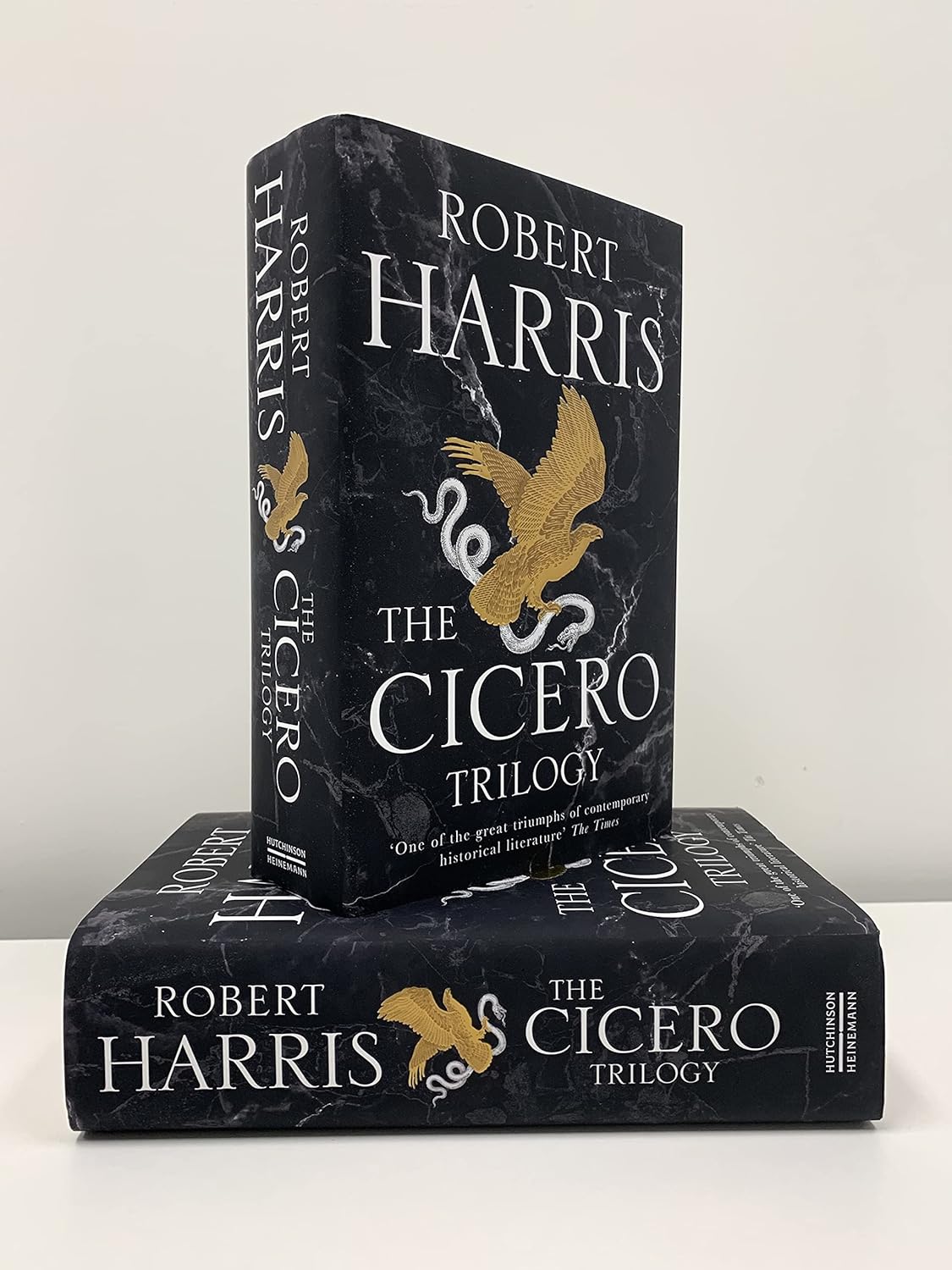
The Cicero Trilogy follows Marcus Tullius Cicero, Rome’s greatest orator and statesman, through the final turbulent decades of the Roman Republic. Narrated by his loyal secretary, Tiro, these novels dramatize Cicero’s rise from an ambitious young lawyer to consul of Rome, and his eventual fall during Rome’s transformation from a republic to an empire.
Harris portrays Cicero not as a marble hero but as a complex, often compromised political operator, brilliant and principled yet also vain and calculating. The trilogy’s power lies in its parallels to modern politics, including populist demagogues, constitutional crises, media manipulation, political violence, and the erosion of democratic norms.
1. Imperium (2006)
Timeline: 79 BC – 64 BC
Historical Event: Cicero’s prosecution of corrupt governor Verres, his rise through Roman political ranks
The first volume introduces us to young Cicero, a 27-year-old ambitious lawyer determined to achieve imperium supreme political power. With no aristocratic connections or military glory, he must rely on his rhetorical brilliance, legal acumen, and political cunning.
The novel’s centerpiece is Cicero’s prosecution of Gaius Verres, the corrupt governor of Sicily, in one of the most famous trials in history. Harris dramatizes the case as a thriller, with political pressures, witness intimidation, and courtroom surprises. Cicero’s victory catapults him toward the highest offices in Rome.
Imperium establishes the series’ narrative technique: intimate first-person narration from Tiro’s perspective, bringing readers inside Cicero’s mind and the machinations of Roman politics. We see Cicero’s calculation, his self-doubt, his tactical genius, and his willingness to compromise principles for the sake of political survival.
2. Lustrum (2009) [Published as Conspirata in the United States]
Timeline: 63 BC – 58 BC
Historical Event: Catiline Conspiracy, Cicero’s consulship, and exile
Lustrum covers Cicero’s consulship, his term as one of Rome’s two chief magistrates, and the immediate aftermath. The central drama is the Catiline Conspiracy, where aristocratic revolutionary Catiline plots to seize power through violence and debt cancellation.
Harris turns this historical episode into a political thriller. Cicero must expose the conspiracy while navigating the complexities of Senate politics, dealing with ambitious rivals such as Julius Caesar and Pompey, and making morally compromising decisions. His decision to execute conspirators without trial, though legally questionable, saves the Republic but sows seeds of his future downfall.
The novel portrays Cicero at the height of his power and the beginning of his decline. Political enemies, led by demagogue Clodius, force him into exile. The book’s title, Lustrum, refers to a five-year period in Roman custom, specifically the five years of Cicero’s greatest triumph and subsequent disaster.
Lustrum was shortlisted for the 2010 Walter Scott Prize for Historical Fiction.
3. Dictator (2015)
Timeline: 58 BC – 43 BC
Historical Event: Caesar’s rise, Roman Civil War, Cicero’s assassination
The trilogy’s conclusion follows Cicero from exile to his eventual murder. We witness Caesar’s conquest of Gaul, Pompey’s downfall, Caesar’s rise to dictatorship and subsequent assassination, and the emergence of Mark Antony and Octavian. Throughout these catastrophic events, Cicero struggles to preserve republican government while navigating between warring factions.
Harris portrays Cicero’s final years with both admiration and clear-eyed assessment. Cicero delivers his greatest speeches (Philippics) denouncing Mark Antony, but his political misjudgments contribute to democracy’s collapse. His assassination in 43 BC by Antony’s soldiers provides the trilogy with its tragic conclusion.
Dictator completes one of historical fiction’s most ambitious projects: a comprehensive portrait of a brilliant, flawed man living through civilization’s transformation. The trilogy’s contemporary relevance, showing how republics fail when political norms collapse, makes it essential reading.
Reading Order Note: The Cicero books must be read in sequence (Imperium → Lustrum → Dictator), as they form a continuous narrative spanning 40 years of Roman history.
Standalone Historical Fiction
Fatherland (1992)
Setting: Nazi Germany, April 1964 (alternate history)
Protagonist: Xavier March, SS investigator
Harris’s breakout novel envisions a world where Nazi Germany emerged victorious in World War II. In 1964, with Hitler celebrating his 75th birthday and preparing for a state visit from U.S. President Joseph Kennedy, SS detective Xavier March investigates what appears to be a simple drowning. The case leads him to uncover evidence of the Holocaust, still secret even within Germany, threatening to expose the regime’s darkest crimes.
Fatherland works as both a gripping detective story and a chilling alternate history. Harris meticulously imagines Nazi victory’s consequences: a German Europe, a cold war with America, and continued genocide. The novel’s power lies in its plausibility and its exploration of how totalitarian regimes maintain power through suppressing truth.
The book sold over three million copies worldwide and was adapted as an HBO television film in 1994, starring Rutger Hauer. It remains one of the most successful alternate history novels ever written.
Enigma (1995)
Setting: Bletchley Park, England, March 1943 (World War II)
Protagonist: Tom Jericho, codebreaker
Set at Bletchley Park during World War II’s peak, Enigma dramatizes British efforts to crack German naval codes. Mathematician Tom Jericho returns to work after a nervous breakdown, racing to break a new German cipher as U-boat attacks threaten Allied supply lines. Simultaneously, he investigates the disappearance of his girlfriend Claire, a Bletchley clerk who may be a German spy.
Harris combines two thrillers: the intellectual puzzle of codebreaking and a spy mystery. He brings Bletchley’s atmosphere vividly to life, brilliant eccentrics working in secrecy, the pressure of lives depending on their success, and the paranoia of counterintelligence.
The novel was adapted as a 2001 film starring Kate Winslet and Dougray Scott, with a screenplay by Tom Stoppard.
Archangel (1998)
Setting: Moscow, Russia, 1990s (contemporary thriller)
Protagonist: Fluke Kelso, historian
Archangel follows British historian Fluke Kelso, who discovers evidence that Stalin kept secret notebooks, hidden away by former KGB officer Papu Rapava. Kelso’s search for these notebooks leads him from Moscow to the remote northern city of Archangel, uncovering a conspiracy involving Stalin’s son and Russia’s post-Soviet power struggles.
This contemporary thriller examines Russia’s failure to confront its totalitarian past. Harris dramatizes the chaos of 1990s Russia, where Soviet-era structures have collapsed, but democracy remains fragile, and the ghost of Stalin still haunts politics.
The novel was adapted for BBC television in 2005, starring Daniel Craig.
Pompeii (2003)
Setting: Roman Empire, Bay of Naples, August AD 79
Protagonist: Marcus Attilius Primus, water engineer
Pompeii takes place during the four days leading up to the catastrophic eruption of Mount Vesuvius. Young water engineer Marcus Attilius arrives to take charge of the Aqua Augusta aqueduct when his predecessor mysteriously disappears. As he investigates failing water supplies, he realizes the truth: Vesuvius is awakening.
Harris transforms historical catastrophe into a thriller. Attilius races against time to understand the geological crisis, rescue the woman he loves (the daughter of the aqueduct’s corrupt contractor), and save as many lives as possible. The novel’s climax, the eruption itself, is devastating and spectacular.
Pompeii demonstrates Harris’s ability to create suspense even when readers know the outcome. His meticulous research (consulting vulcanologists, studying Roman engineering) creates an immersive ancient world. The novel was adapted as a film screenplay by Harris for Roman Polanski; however, the project was ultimately directed by a different filmmaker.
An Officer and a Spy (2013)
Setting: France, 1890s
Protagonist: Colonel Georges Picquart
Historical Event: Dreyfus Affair
Harris’s most acclaimed novel dramatizes the Dreyfus Affair, one of history’s most notable miscarriages of justice. Colonel Georges Picquart, promoted to head France’s counterintelligence after Captain Alfred Dreyfus was convicted of spying, gradually realizes Dreyfus was framed. The real spy, Major Esterhazy, remains free. Picquart’s attempts to expose the truth put him in conflict with the French military, government, and rising anti-Semitic movement.
An Officer and a Spy works as both an espionage thriller and a moral drama. Harris portrays Picquart as an unlikely hero, initially anti-Semitic himself, a career officer risking everything for truth. The novel explores institutional corruption, the dangers of nationalism, and the power of journalism.
The book won four prizes, including the Walter Scott Prize for Historical Fiction and the Crime Writers’ Association Award. Roman Polanski adapted it as the 2019 film J’Accuse (released in the U.S. as An Officer and a Spy), co-written by Harris.
Munich (2017)
Setting: Munich, Germany, September 1938
Historical Event: Munich Conference
Protagonists: Hugh Legat (British) and Paul von Hartmann (German), former Oxford friends
Munich dramatizes the 1938 Munich Conference, where Britain’s Neville Chamberlain attempted to appease Hitler. Two former Oxford friends, Hugh Legat, now in Chamberlain’s diplomatic service, and Paul von Hartmann, working in the German foreign ministry, find themselves on opposite sides but share a desperate desire to prevent war.
Harris provides revisionist sympathy for Chamberlain, portraying him as a man trying to avoid repeating the carnage of World War I, even as his appeasement policy proves disastrous. The novel poses challenging questions about when to compromise and when to resist, making it relevant to contemporary debates about confronting authoritarian regimes.
The taut narrative unfolds over 72 hours, interweaving conference negotiations with a conspiracy plot and the reunion of old friends. Harris’s journalistic background shines in his portrayal of diplomatic maneuvering.
Act of Oblivion (2022)
Setting: England and New England, 1660-1674
Protagonists: Richard Nayler (fictional), Edward Whalley, and William Goffe (historical regicides)
Historical Event: Pursuit of King Charles I’s killers after the Restoration
The Act of Oblivion follows the hunt for regicides, men who signed King Charles I’s death warrant, after his son, Charles II, reclaimed the throne in 1660. Richard Nayler of the Privy Council tracks Whalley and Goffe to the American colonies, initiating a decade-long manhunt that spans Massachusetts and Connecticut.
The novel works as both a historical adventure and a meditation on justice, revenge, and political memory. Harris uses the chase structure to explore early American colonial society, Puritan culture, and England’s post-Civil War settlement. Notably, all named characters except Nayler are historical figures, demonstrating Harris’s commitment to historical accuracy.
Act of Oblivion showcases Harris’s mature style, featuring morally complex characters, thorough research, and an ability to make 17th-century events feel immediate and relevant.
Precipice (2024)
Setting: London, England, May-August 1914
Protagonist: Young British intelligence officer
Historical Context: Prime Minister H.H. Asquith’s affair with Venetia Stanley, the outbreak of WWI
Harris’s most recent novel explores the eve of World War I through a lens of political scandal. A young intelligence officer investigates the disappearance of top-secret government documents during Prime Minister Asquith’s indiscreet affair with Venetia Stanley. As diplomatic crisis escalates toward war, personal and political crises intersect.
Precipice continues Harris’s examination of how democracies function and fail during crisis. The novel dramatizes the months when Europe slid toward catastrophe, with personal obsessions and political miscalculations contributing to civilizational disaster.
The book demonstrates Harris’s continued productivity and ambition at age 67, tackling a new historical period with the same meticulous research that characterizes his entire career.
Contemporary Thrillers
The Ghost (2007)
Setting: Contemporary (2000s)
Protagonist: Unnamed ghostwriter
Inspiration: Tony Blair
A professional ghostwriter is hired to complete the memoirs of Britain’s former prime minister (a barely disguised Tony Blair) after the previous ghostwriter drowns mysteriously. Secluded in a mansion on Martha’s Vineyard, the ghostwriter discovers his predecessor was murdered after uncovering damaging secrets about the prime minister’s ties to American intelligence.
The Ghost channels Harris’s disillusionment with Tony Blair, his former friend, over the Iraq War. The novel satirizes Blair’s relationship with America, media manipulation, and the dishonesty of political memoirs. Harris also explores the ghostwriter’s role in shaping political narratives.
Roman Polanski adapted the novel as the acclaimed 2010 film The Ghost Writer, starring Ewan McGregor and Pierce Brosnan. Harris co-wrote the screenplay. The film was nominated for numerous awards and won the European Film Award for Best Screenplay.
The novel’s prescience about political corruption and intelligence agency overreach has aged remarkably well.
The Fear Index (2011)
Setting: Geneva, Switzerland, 2010 (contemporary)
Protagonist: Dr. Alex Hoffmann, hedge fund manager
The Fear Index ventures into financial thriller territory with science fiction undertones. Dr. Alex Hoffmann has created an algorithm that trades based on market fear, generating billions for his hedge fund. When a mysterious intruder breaches his ultra-secure mansion, Hoffmann’s life spirals into a state of paranoia. Is someone targeting him, or has his artificial intelligence become autonomous?
Harris explores high-frequency trading, algorithmic finance, and the dangers of artificial intelligence. The novel raises questions about whether we control our technology or it controls us, a theme increasingly relevant as AI advances.
The book combines Harris’s trademark suspense with an exploration of the darker implications of cutting-edge technology. It demonstrates his versatility beyond historical fiction.
The Second Sleep (2019)
Setting: Post-apocalyptic England, circa 1468 (actually future)
Protagonist: Father Christopher Fairfax, young priest
The Second Sleep initially appears to be medieval historical fiction, but reveals itself as post-apocalyptic. A young priest investigates an old priest’s death in a remote village and discovers artifacts from an advanced civilization, our own, destroyed centuries earlier in a catastrophic “systemic” collapse.
Harris uses the setup to explore the fragility of civilization and the double-edged nature of technology. The medieval surface conceals warnings about climate change, technological dependence, and societal collapse. Characters debate whether recovered ancient knowledge should be suppressed or embraced.
The novel shows Harris experimenting with genre while maintaining his core concerns: how institutions control information, how societies remember or forget, and how knowledge can be both liberating and dangerous.
V2 (2020)
Setting: Northern France and London, November 1944
Protagonists: RAF officer (British) and German rocket engineer
Historical Context: V-2 rocket attacks on London
V2 interweaves two perspectives during the final months of World War II: a female RAF officer working to locate V-2 launch sites, and a German rocket engineer forced to continue supporting a losing war. As V-2 missiles rain on London, both protagonists race against time—one to stop the attacks, one to survive the war.
Harris returns to World War II with a focus on the role of technology in warfare. The novel explores the V-2’s development, Nazi weapons programs, and the ethical compromises scientists make under totalitarian regimes. It also dramatizes the experiences of ordinary people under constant aerial bombardment.
V2 demonstrates Harris’s continued mastery of the WWII thriller while exploring themes of technological warfare relevant to modern drone conflicts.
Upcoming Novel
Agrippa (August 2026)
Harris’s next novel will return to ancient Rome, following Marcus Vipsanius Agrippa, the general and architect who was Augustus’s closest friend and most trusted ally. The novel will be structured as Agrippa’s memoirs, recounting his friendship with Octavian (later Augustus) and his pivotal role in shaping the Roman Empire.
Agrippa is one of ancient history’s most fascinating yet under-appreciated figures—the military genius who won Augustus’s battles, the administrator who built the Pantheon, the loyal friend who never sought supreme power for himself. Harris’s treatment promises to be both a character study and an exploration of partnership, loyalty, and the construction of empires.
This return to Roman history suggests Harris views ancient politics as continually relevant to understanding modern power dynamics.
Where to Start with Robert Harris
Best First Book
Recommendation: Fatherland
For readers new to Robert Harris, Fatherland remains the ideal starting point. It’s his most famous work, combines historical fiction with detective thriller elements, and showcases everything that makes Harris exceptional: meticulous world-building, political complexity, moral seriousness, and page-turning suspense.
The alternate history premise makes it accessible even for readers less interested in strict historical fiction. You don’t need extensive knowledge of WWII to appreciate Fatherland‘s chilling what-if scenario. The detective plot provides narrative momentum while Harris explores deeper themes about totalitarianism, truth, and human complicity in evil.
At 368 pages, it’s shorter than his later novels, making it a manageable introduction. If you enjoy Fatherland, you’ll know whether Harris’s other work will appeal to you.
If You Want…
Ancient Rome and political intrigue: Start with Imperium, the first Cicero book. It establishes the trilogy while working as a standalone story with a satisfying conclusion.
World War II thriller: Try Enigma for codebreaking drama or V2 for technological warfare. Both offer different perspectives on World War II beyond combat.
Contemporary political thriller: Begin with The Ghost for thinly veiled political satire, or Conclave for Vatican intrigue. Both work as stand-alone reads without requiring a historical background.
Literary historical fiction with an awards pedigree: An Officer and a Spy won four major prizes and offers everything Harris does best: moral complexity, institutional critique, and narrative drive.
Science fiction elements: The Second Sleep offers post-apocalyptic speculation within a historical fiction framework. Perfect for readers who enjoy both genres.
Recent bestseller with film adaptation: Conclave (2016) has recently been adapted into a critically acclaimed film starring Ralph Fiennes. The novel is a quick, thrilling read about papal politics.
Reading Order Recommendations
For the Cicero Trilogy: Must be read in publication order:
- Imperium (2006)
- Lustrum (2009)
- Dictator (2015)
For Standalone Novels: Can be read in any order based on your interests and time period preferences.
Thematic Reading Order:
- WWII/Alternate History: Fatherland → Enigma → V2
- Ancient Rome: Pompeii → Imperium → Lustrum → Dictator → Agrippa (2026)
- Contemporary Thrillers: The Ghost → The Fear Index → The Second Sleep
- Political Scandals & Institutional Corruption: An Officer and a Spy → Munich → Conclave → Precipice
Explore more:
Robert Harris Movies and Adaptations
Harris’s cinematic success showcases the visual power and narrative strength of his novels. Nine of his books have been adapted for film and television:
The Ghost Writer (2010)
Director: Roman Polanski
Stars: Ewan McGregor, Pierce Brosnan, Kim Cattrall, Olivia Williams
Based on: The Ghost (2007)
Roman Polanski’s adaptation of The Ghost earned widespread acclaim for its atmospheric direction and strong performances. Ewan McGregor plays the unnamed ghostwriter, while Pierce Brosnan channels Tony Blair as the ex-prime minister with dark secrets.
Harris co-wrote the screenplay with Polanski, ensuring fidelity to the novel’s political themes. The film premiered at the 2010 Berlin International Film Festival, where it won the Silver Bear for Best Director. It also won the European Film Award for Best Screenplay.
Critical reception praised the film’s Hitchcockian suspense and political relevance. The adaptation demonstrates Harris’s skill at translating his novels to the screen.
An Officer and a Spy (2019) [Released as J’Accuse in some territories]
Director: Roman Polanski
Stars: Jean Dujardin, Louis Garrel, Emmanuelle Seigner
Based on: An Officer and a Spy (2013)
Polanski’s second adaptation of Harris’s work dramatizes the Dreyfus Affair with meticulous period detail. Jean Dujardin plays Colonel Picquart, the officer who exposed the French military’s conspiracy. The film won the Grand Jury Prize at the 2019 Venice Film Festival and three César Awards, including Best Director.
Harris again co-wrote the screenplay. The film’s release became controversial due to Polanski’s personal legal issues, overshadowing what many critics considered excellent filmmaking.
Conclave (2024)
Director: Edward Berger
Stars: Ralph Fiennes, Stanley Tucci, John Lithgow, Isabella Rossellini
Based on: Conclave (2016)
U.S. Release: October 25, 2024
The most recent Harris adaptation became one of 2024’s critical and commercial successes. Ralph Fiennes stars as Cardinal Lawrence, tasked with managing the papal election after the Pope’s unexpected death. As Cardinals gather from around the world, Lawrence discovers conspiracies that could shake the Catholic Church’s foundation.
Director Edward Berger (All Quiet on the Western Front) creates a taut political thriller from Vatican intrigue. The screenplay by Peter Straughan earned praise for maintaining the novel’s suspense while adapting to the film’s visual medium.
Conclave premiered at the Telluride Film Festival in August 2024 to strong reviews (93% on Rotten Tomatoes). Focus Features released it wide on October 25, 2024, where it grossed over $127 million worldwide on a $20 million budget—a significant commercial success for adult-oriented drama.
Ralph Fiennes’s performance earned widespread acclaim, with many predicting it would be considered for awards. The film’s release coincided eerily with real-world Vatican politics, increasing public interest.
Harris served as producer on the film, ensuring his vision was realized on screen.
Earlier TV Adaptations
Fatherland (1994)
HBO television film starring Rutger Hauer and Miranda Richardson. While taking liberties with the source material (adding a romance, changing the ending), it introduced Harris’s work to American audiences.
Archangel (2005)
BBC television adaptation starring Daniel Craig in one of his pre-Bond roles. The mini-series follows the novel’s plot, which involves hunting for Stalin’s secret notebooks in post-Soviet Russia.
Enigma (2001)
Feature film starring Kate Winslet, Dougray Scott, and Jeremy Northam. Screenplay by Tom Stoppard. While well-made, it altered significant plot elements from the novel by Harris.
Unmade or Upcoming Adaptations
Pompeii: Harris wrote a screenplay for Roman Polanski in 2007, but the project never materialized. A different Pompeii film (unrelated to Harris’s novel) was made by Paul W.S. Anderson in 2014.
Munich: No adaptation has been announced yet, although the novel’s taut 72-hour timeframe would translate well to film.
The Fear Index: Discussed for adaptation but not yet produced. The tech-thriller premise could work as a contemporary film or a limited series.
Awards and Recognition
Robert Harris’s consistent excellence has earned major literary recognition:
Major Awards Won:
- Walter Scott Prize for Historical Fiction (2014) – An Officer and a Spy
- Crime Writers’ Association Award (2014) – An Officer and a Spy
- International Thriller Writers Award (2008)
- CBE (Commander of the Order of the British Empire) – Awarded for services to literature
Significant Honors:
- Fellow of the Royal Society of Literature
- Honorary Degrees from Cambridge and other universities
- Multiple bestseller list appearances in the UK, US, and internationally
Critical Recognition:
An Officer and a Spy won four prizes in one year (2014), unprecedented for a popular thriller. Critics praised it as Harris’s masterpiece, combining historical accuracy, moral complexity, and page-turning narrative.
Lustrum was shortlisted for the 2010 Walter Scott Prize, demonstrating the literary credibility of the Cicero trilogy.
The Fear Index and The Second Sleep both received strong critical attention despite being contemporary/speculative rather than strictly historical.
Commercial Success:
Harris’s books have sold over ten million copies worldwide and been translated into 40 languages. His novels routinely debut at number one on UK bestseller lists. Fatherland alone sold three million copies.
Film Success:
Nine film/TV adaptations demonstrate his work’s cinematic appeal. The Ghost Writer and An Officer and a Spy both won major European film awards. Conclave became one of 2024’s most successful adult dramas.
Similar Authors You’ll Enjoy
If you love Robert Harris’s intelligent historical thrillers, try these authors:
Alan Furst is a master of European spy fiction, set in the 1930s and 1940s, and is an American author. Like Harris, Furst combines meticulous historical research with atmospheric storytelling. Try ‘Night Soldiers’ or ‘Mission to Paris’.
Philip Kerr – British author whose Bernie Gunther series features a Berlin detective navigating Nazi Germany. More hardboiled than Harris but equally well-researched. Start with March Violets.
John le Carré – While focused on Cold War espionage rather than ancient history, le Carré shares Harris’s interest in institutional corruption and moral ambiguity. Try Tinker Tailor Soldier Spy or A Perfect Spy.
Len Deighton – Harris cited Deighton’s SS-GB as inspiration for Fatherland. Both authors excel at alternate history and spy fiction. Try The Ipcress File or Bomber.
C.J. Sansom – Author of the Shardlake series set in Tudor England. Like Harris, Sansom combines elements of legal/political thrillers with a historical setting. Start with Dissolution.
David Baldacci – For readers who enjoy Harris’s contemporary political thrillers, like The Ghost, Baldacci offers a similar blend of paranoia and political conspiracy. Try Absolute Power.
Colleen McCullough’s “Masters of Rome” series covers similar Roman territory to Harris’s Cicero trilogy, but from multiple perspectives. Epic in scope. Start with The First Man in Rome.
Steven Saylor – Roma Sub Rosa series features detective Gordianus solving mysteries in ancient Rome. More traditional mystery than Harris, but equally well-researched.
Ben Kane – British author of Roman military fiction. More action-oriented than Harris but historically accurate. Try his Eagles of Rome series.
Related Content:
Frequently Asked Questions
What is Robert Harris’s best book?
Most readers and critics consider An Officer and a Spy (2013) Robert Harris’s best standalone novel. It won four major prizes, including the Walter Scott Prize for Historical Fiction, and demonstrates his mature style, characterized by moral complexity, institutional critique, and narrative drive. The Dreyfus Affair provides inherently dramatic material, and Harris’s portrayal of Colonel Picquart’s courage is both inspiring and nuanced.
However, the Cicero Trilogy (Imperium, Lustrum, Dictator) represents his most ambitious achievement—a decade-long project dramatizing the fall of the Roman Republic with contemporary relevance. Many consider this his masterpiece.
For alternate history fans, Fatherland (1992) remains his most famous work and the book that made his career. Its chilling Nazi-victory scenario has influenced the entire alternate history genre.
In what order should I read Robert Harris’s books?
The Cicero Trilogy must be read in order:
- Imperium (2006)
- Lustrum (2009)
- Dictator (2015)
These books form one continuous narrative and should not be read out of sequence.
All other Robert Harris novels are standalone and can be read in any order based on your interests. Choose by time period, theme, or what sounds most appealing.
Recommended thematic order:
- Ancient Rome: Pompeii → Cicero Trilogy
- WWII: Fatherland → Enigma → Munich → V2
- Political thrillers: The Ghost → Conclave → Precipice
Is Robert Harris historically accurate?
Yes, Robert Harris’s historical research is exceptionally thorough. His background as a journalist had trained him to verify facts, consult primary sources, and understand the mechanics of politics.
For the Cicero trilogy, Harris read Cicero’s letters in Latin, studied Roman institutions alongside leading classicists, and conducted daily research on ancient Roman life. The political events, dates, and major characters are historically accurate. Where he takes creative liberty is in dialogue and characters’ interior thoughts.
For Pompeii, he consulted vulcanologists about Vesuvius’s eruption and studied Roman engineering. For Enigma, he conducted extensive research at Bletchley Park. For An Officer and a Spy, he closely followed the documentary record of the Dreyfus Affair.
Harris’s alternate histories (Fatherland, The Second Sleep) obviously deviate from real events, but even these are grounded in realistic extrapolation of historical trends.
Historians generally praise Harris’s accuracy while noting that any historical fiction involves creative interpretation.
How old is Robert Harris?
Robert Harris was born on March 7, 1957, making him 67 years old as of 2025. He continues writing actively, with Precipice published in 2024 and Agrippa scheduled for August 2026.
How many books has Robert Harris written?
Robert Harris has written 16 novels:
- The Cicero Trilogy (3 books): Imperium, Lustrum, Dictator
- 13 standalone novels from Fatherland (1992) to Precipice (2024)
- Plus upcoming: Agrippa (2026)
He has also written five non-fiction books on politics and history, including Selling Hitler (1986) about the Hitler Diaries scandal and A Higher Form of Killing (1982, with Jeremy Paxman) about chemical warfare.
In total, Robert Harris has published 21 books (16 novels + 5 non-fiction), with a 17th novel coming in 2026.
Where does Robert Harris live?
Robert Harris lives in Kintbury, near Hungerford in Berkshire, England, with his wife Gill Hornby. They live in a converted former vicarage that Harris purchased with proceeds from Fatherland—he jokingly calls it “the house that Hitler built.”
Kintbury is a village in West Berkshire, approximately 60 miles west of London, offering Harris rural peace for writing while remaining accessible to London’s literary scene.
Which Robert Harris books have been adapted into films?
Nine Robert Harris books have been adapted for film or television:
Major Feature Films:
- The Ghost Writer (2010) – Roman Polanski film starring Ewan McGregor
- An Officer and a Spy (2019) – Roman Polanski film starring Jean Dujardin
- Conclave (2024) – Edward Berger film starring Ralph Fiennes (major 2024 success)
Earlier TV Adaptations:
- Fatherland (1994) – HBO film starring Rutger Hauer
- Enigma (2001) – Feature film starring Kate Winslet
- Archangel (2005) – BBC mini-series starring Daniel Craig
Harris co-wrote screenplays for The Ghost Writer and An Officer and a Spy with Roman Polanski, and served as producer on Conclave.
What is Robert Harris’s latest book?
Robert Harris’s latest novel is Precipice (2024), a WWI-era thriller about a British intelligence officer investigating disappearing state secrets during Prime Minister H.H. Asquith’s affair with Venetia Stanley. Set in May-August 1914 as Europe slides toward war, it combines political scandal with espionage.
His next book, Agrippa, is scheduled for publication in August 2026. It will return to ancient Rome, following Augustus’s friend and general Marcus Agrippa through his memoirs.
What should I read first if I’m new to Robert Harris?
Start with Fatherland (1992) if you want to understand what made Harris famous. It’s accessible, gripping, and showcases his strengths: an alternate history thriller combining a detective plot with political complexity.
Alternatively, try Conclave (2016) for a quick, contemporary thriller that demonstrates his ability to create suspense from political maneuvering. At under 300 pages and with a 72-hour timeframe, it’s perfect for readers seeking a concise introduction.
For fans of ancient Rome, Imperium works as both a standalone and a series opener.
Avoid starting with Lustrum or Dictator (requires reading Imperium first) or The Second Sleep (his most experimental novel).
Is Robert Harris writing another Cicero book?
No, Robert Harris has confirmed the Cicero Trilogy is complete. Dictator (2015) concluded Cicero’s story with his assassination in 43 BC.
However, Harris is returning to ancient Rome with Agrippa (2026), which will follow Augustus’s friend and general. While not about Cicero, it covers some of the same historical period from a different perspective.
When did Robert Harris write Conclave?
Robert Harris published Conclave in 2016, although he had written it in 2015. The novel’s 2024 film adaptation, directed by Edward Berger and starring Ralph Fiennes, brought renewed attention to the book.
The film’s October 2024 release coincided with real-world Vatican events (Pope Francis’s health issues in 2025), creating unexpected relevance and commercial success.
How many languages has Robert Harris been translated into?
Robert Harris’s work has been translated into 40 languages, demonstrating his international appeal. His novels are particularly popular in:
- Germany (where Fatherland was especially successful)
- France (where An Officer and a Spy resonated, given its French subject)
- Italy and Spain
- Scandinavia
- Eastern Europe
The Cicero Trilogy has found a strong audience in countries with a strong classical education tradition.
What is Robert Harris’s connection to Roman Polanski?
Robert Harris and Roman Polanski have collaborated on three film adaptations:
- The Ghost Writer (2010) – Harris co-wrote the screenplay with Polanski
- An Officer and a Spy (2019) – Harris co-wrote the screenplay with Polanski
- Pompeii – Harris wrote a screenplay in 2007 for Polanski (never produced)
Harris credits Polanski with inspiring An Officer and a Spy—Polanski’s enthusiasm for the Dreyfus Affair motivated Harris to write the novel. Their friendship has proven creatively fruitful despite controversy surrounding Polanski’s personal life.
Both men share an interest in institutional power, conspiracy, and paranoia, making them natural collaborators. Harris’s political journalism background complements Polanski’s cinematic eye for suspense.
Conclusion
Robert Harris stands as one of contemporary fiction’s most accomplished and versatile authors. Across 16 novels spanning 32 years, he has demonstrated a remarkable range from ancient Rome to Nazi Germany, from Tudor politics to Vatican intrigue, from WWII codebreaking to post-apocalyptic speculation, while maintaining consistent quality, intelligence, and narrative drive.
What distinguishes Harris is his ability to make history feel urgent and contemporary. Whether dramatizing Cicero’s struggle to preserve Roman democracy or imagining Nazi victory’s consequences, his novels ask timeless questions about power, corruption, truth, and institutional failure. His journalism background provides an insider understanding of how politics actually works, elevating his fiction beyond simplified heroes and villains.
The Cicero Trilogy alone would secure Harris’s legacy a decade-long project that brings ancient Rome vividly to life while illuminating modern political dysfunction. Add Fatherland‘s influence on alternate history, An Officer and a Spy‘s four major prizes, and Conclave‘s 2024 film success, and you have an author at the peak of his powers who shows no signs of slowing down.
For readers who appreciate intelligent historical fiction, political thrillers with moral complexity, and prose that balances readability with literary ambition, Robert Harris offers an essential body of work. Whether you’re drawn to ancient Rome, World War II, contemporary scandals, or speculative futures, Harris has written something that will challenge your mind while keeping you turning pages late into the night.
Ready to begin your Robert Harris journey? Start with Fatherland to understand what made him famous, or dive into Imperium to experience his mature historical fiction. With Agrippa coming in 2026, there’s never been a better time to explore one of Britain’s greatest living novelists.
Related Content
- Best Historical Fiction of All Time
- Best Ancient Rome Historical Fiction
- Best WWII Historical Fiction
- Bernard Cornwell: Complete Guide
- Conn Iggulden: Complete Guide
- More Historical Fiction Authors