
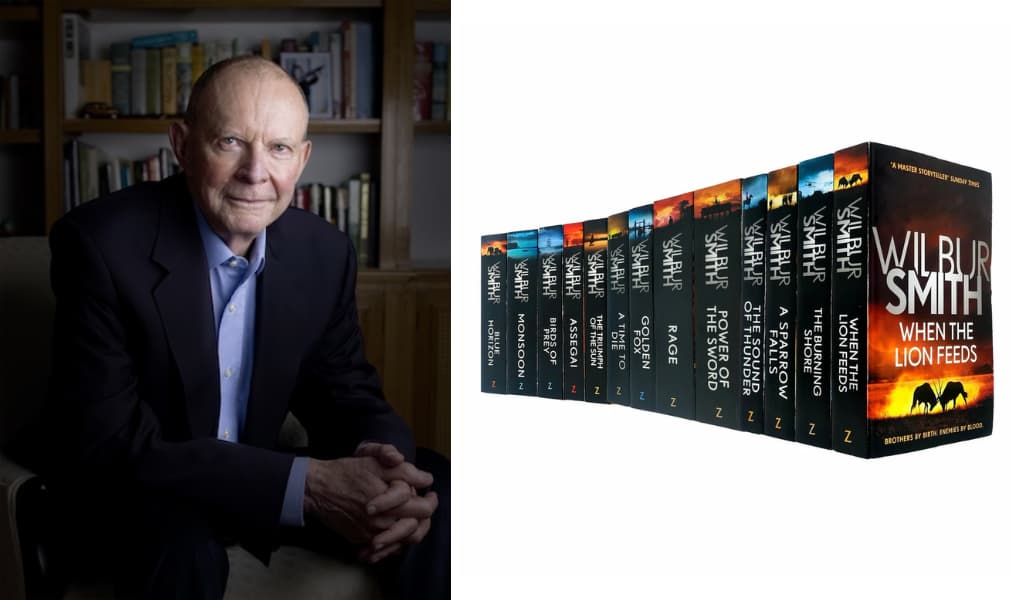

Wilbur Smith was one of the most successful adventure novelists of all time, with over 140 million books sold worldwide in more than 30 languages. His sweeping sagas of adventure, treasure, and survival across Africa and ancient Egypt captivated readers for nearly six decades, establishing him as the master of historical adventure fiction.
Smith is best known for his multi-generational Courtney family saga, which spans three centuries of African history, and his Egyptian series featuring the scribe Taita. His novels combine meticulous historical research with breathtaking action sequences, complex family dynamics, and vivid portrayals of Africa’s landscapes and wildlife. Whether set in colonial Rhodesia, ancient Egypt, or on the high seas, his books deliver the epic scope and visceral excitement that made him a global phenomenon.
Disclosure: This article contains affiliate links. We earn from qualifying purchases at no extra cost to you.About Wilbur Smith
Early Life and Background
Wilbur Addison Smith was born on January 9, 1933, in Broken Hill, Northern Rhodesia (now Kabwe, Zambia). He grew up on his father’s cattle ranch, developing a lifelong passion for Africa’s wilderness, wildlife, and history. This childhood immersion in the African landscape would become the foundation of his writing career.
Smith attended Michaelhouse, a prestigious boarding school in South Africa, and later studied at Rhodes University, where he earned a Bachelor of Commerce degree. After a brief stint working for his father and in the mining industry, he turned to writing full-time after the success of his first novel.
Writing Career
Smith’s debut novel, When the Lion Feeds (1964), introduced the Courtney family and became an immediate bestseller. The book’s success allowed him to become a full-time writer, and he never looked back. Over the next 57 years, he published 49 novels during his lifetime, with several more completed posthumously by co-authors working from his outlines.
His breakthrough came with his early adventure novels set in Africa, including The Dark of the Sun (1965), Shout at the Devil (1968), and Gold Mine (1970). These standalone thrillers established his reputation for fast-paced action and authentic African settings. Several were adapted into films, including “The Dark of the Sun” (starring Rod Taylor) and “Shout at the Devil” (starring Lee Marvin and Roger Moore).
Smith’s career reached new heights with the publication of “River God” (1993), which launched his Egyptian series and proved that he could master ancient history as compellingly as he portrayed modern Africa. The novel spent months on bestseller lists and introduced readers to Taita, one of his most beloved characters.
In his later years, Smith collaborated with other authors to expand his universes and ensure his legacy would continue. Following his death on November 13, 2021, at the age of 88, several books were completed and published based on his detailed outlines and notes.
Writing Style and Approach
Smith’s writing is characterized by sweeping narratives that span generations, continents, and centuries. His prose is direct and muscular, prioritizing action and momentum over literary flourishes. He excelled at creating larger-than-life characters, epic set pieces, and intricate plots involving treasure hunts, family feuds, and survival against overwhelming odds.
His historical research was meticulous. Smith traveled extensively throughout Africa and Egypt, visiting the locations he described and consulting with historians, archaeologists, and wildlife experts. This attention to detail gives his novels an authenticity that grounds even the most dramatic plot developments.
What readers love most about Smith’s work is his ability to transport them completely into another time and place. His descriptions of the African bush, ancient Egyptian palaces, and stormy seas are so vivid that readers feel the heat, smell the dust, and hear the roar of lions. Combined with relentless pacing and high stakes, his novels are nearly impossible to put down.
Wilbur Smith Series in Reading Order
Courtney Series (22 books, complete)
Setting: Southern Africa and the Indian Ocean, spanning from the 1660s to the 1980s
Number of Books: 22 books (19 main novels + 3 Jack Courtney YA novels)
Main Characters: Multiple generations of the Courtney family
The Courtney series is Smith’s magnum opus, a multi-generational saga following one family through three centuries of African history. The series is divided into several sequences that can be read somewhat independently, though they all connect through the Courtney bloodline. The novels explore themes of colonization, war, family loyalty, betrayal, and the complex relationship between Europeans and Africa.
Reading Order (Publication Order Recommended):
- When the Lion Feeds (1964) – Sean Courtney’s coming-of-age story in 1870s South Africa during the Zulu Wars. The novel that started it all, introducing readers to the Courtney family’s courage, ambition, and capacity for both great love and terrible violence.
- The Sound of Thunder (1966) – Sean Courtney during the Boer War. A powerful examination of war’s brutality and the political tensions tearing South Africa apart at the turn of the century.
- A Sparrow Falls (1977) – The conclusion of Sean Courtney’s story, set during and after World War I. Follows Sean’s sons as they navigate love, war, and the changing face of Africa.
- The Burning Shore (1985) – Centaine de Thiry’s survival story during WWI, connecting to the Courtney family. A gripping tale of a pregnant French woman’s struggle to survive in the African wilderness.
- Power of the Sword (1986) – The rise of the Courtney family’s power in 1930s South Africa. Political intrigue and family conflict against the backdrop of growing Afrikaner nationalism.
- Rage (1987) – The Courtneys during the apartheid era. Smith’s most politically charged novel examines the moral complexities of South Africa’s darkest period.
- A Time to Die (1989) – Set during the Rhodesian Bush War of the 1970s-80s. A visceral, action-packed thriller about mercenaries, betrayal, and survival.
- Golden Fox (1990) – International espionage involving the Courtney family during the Cold War. Expands the series beyond Africa to include global political intrigue.
- Birds of Prey (1997) – Chronologically the earliest Courtney novel, set in 1667. A swashbuckling maritime adventure featuring the family’s origins as they battle the Dutch, Arabs, and pirates on the Indian Ocean.
- Monsoon (1999) – Continues the 17th-century maritime adventures. Epic sea battles, treasure hunts, and exotic locales from Arabia to India.
- Blue Horizon (2003) – Follows the next generation of Courtneys in the 18th century. Embark on an adventure across the African interior as the family establishes itself in the Cape.
- The Triumph of the Sun (2005) – Set during the Siege of Khartoum (1884-85). The Courtneys were caught in one of history’s most dramatic military disasters.
- Assegai (2009) – Leon Courtney in East Africa before World War I. Big game hunting, romance, and the looming shadow of war in colonial Kenya.
- Golden Lion (2015, with Giles Kristian) – Returns to the 17th century for more maritime adventures. First of Smith’s collaborative novels, maintaining his signature style while bringing fresh energy.
- War Cry (2017, with David Churchill) – The Courtney family during World War II. Multiple storylines across different theaters of war, from North Africa to the Eastern Front.
- The Tiger’s Prey (2017, with Tom Harper) – Another 17th-century adventure featuring merchant trading and piracy in India. Expands the early Courtney timeline with new characters and conflicts.
- Courtney’s War (2018, with David Churchill) – Continues the World War II storyline. Focuses on resistance fighters, espionage, and the brutal realities of occupied Europe.
- King of Kings (2019, with Imogen Robertson) – Set during the Italian invasion of Ethiopia (1935). Historical detail combined with the Courtney family’s involvement in African politics.
- Legacy of War (2021, with David Churchill) – Post-WWII Africa and the struggle for independence. One of Smith’s final novels, published shortly before his death.
Jack Courtney Young Adult Series:
- Cloudburst (2020) – Modern-day adventure featuring teenage Jack Courtney. Written for younger readers, but maintaining Smith’s adventure DNA.
- Thunderbolt (2021) – Jack Courtney’s second adventure. Environmental themes mixed with classic treasure-hunting excitement.
- Shock Wave (2022, posthumous) – Completed after Smith’s death. Jack faces new dangers in contemporary Africa.
Ballantyne Series (4 books, complete)
Setting: Rhodesia (modern Zimbabwe), 1860s-1980s
Number of Books: 4 books
Main Characters: The Ballantyne family across four generations
The Ballantyne series follows another prominent family in Rhodesian history, often intersecting with the Courtneys. These novels explore the creation and ultimate fall of Rhodesia, examining colonialism, independence struggles, and the complex racial dynamics of southern Africa.
Reading Order:
- A Falcon Flies (1980) – Robyn Ballantyne’s journey into Africa in the 1860s. A young Englishwoman’s quest to find her missing missionary father becomes an exploration of the slave trade and the impact of colonial expansion.
- Men of Men (1981) – The diamond rush at Kimberley. The Ballantynes and Courtneys intersect as fortunes are made and lost in the diamond fields.
- The Angels Weep (1982) – The Matabele Rebellion and early 20th-century Rhodesia. Chronicles the violent conflicts between settlers and indigenous peoples.
- The Leopard Hunts in Darkness (1984) – Modern Rhodesia/Zimbabwe during the transition to independence. A thriller examining the end of white rule and the birth of a new nation.
Egyptian Series (8 books, complete)
Setting: Ancient Egypt, spanning multiple dynasties
Number of Books: 8 books
Main Character: Taita, a eunuch slave who becomes a legendary scribe, physician, and warrior
The Egyptian series showcases Smith’s versatility, proving he could bring ancient history to life as vividly as African adventures. These novels follow Taita through multiple lifetimes (some books feature his reincarnation or extreme longevity), creating an epic that spans thousands of years of Egyptian history.
Reading Order:
- River God (1993) – Taita’s origin story in the Middle Kingdom. The novel that launched Smith’s Egyptian obsession, featuring court intrigue, war with the Hyksos, and Taita’s devotion to his mistress Lostris.
- The Seventh Scroll (1995) – A modern-day archaeological thriller connected to Taita’s story. Treasure hunters seek Taita’s legendary tomb, alternating between past and present.
- Warlock (2001) – Young Prince Nefer’s coming of age with Taita as his mentor. Epic battles and magical elements as Egypt faces invasion.
- The Quest (2007) – Taita’s mystical journey to save Egypt from drought. Smith’s most fantastical novel incorporates magic and mythology.
- Desert God (2014) – Taita in his later years, facing new threats to Egypt. Political intrigue and military campaigns across the ancient Near East.
- Pharaoh (2016) – Taita’s final adventures in life. Smith’s last solo Egyptian novel brings the scribe’s story full circle.
- The New Kingdom (2021, with Mark Chadbourn) – Returns to the aftermath of River God. Completed posthumously but based on Smith’s outlines.
- Titans of War (2022, with Mark Chadbourn) – Continues the Egyptian saga. Published after Smith’s death, it maintains his epic scope.
Standalone Novels (15 books)
Smith’s standalone novels showcase his range, from maritime adventures to modern thrillers. These books don’t require prior knowledge of the series and can be read in any order.
Adventure Thrillers:
- The Dark of the Sun (1965) – Mercenaries in the Congo during the 1960s crisis. Brutal, fast-paced, and one of Smith’s most visceral novels.
- Shout at the Devil (1968) – WWI adventure in East Africa. Later adapted into a film starring Lee Marvin and Roger Moore.
- Gold Mine (1970) – Corporate intrigue and sabotage in a South African gold mine. Suspenseful and claustrophobic.
- The Sunbird (1972) – Archaeological mystery involving a lost African civilization. Combines adventure with Smith’s love of African history.
- The Diamond Hunters (1974) – Treasure hunting off the coast of South Africa. Underwater adventure mixed with corporate betrayal.
- Eagle in the Sky (1974) – An Israeli fighter pilot’s story during the conflicts of the 1970s. Smith’s only major novel is set outside Africa.
- The Eye of the Tiger (1975) – Modern treasure-hunting adventure in the Indian Ocean. A classic page-turner with exotic locations.
- Cry Wolf (1976) – Set during the Italian invasion of Ethiopia in 1935. Adventure, romance, and historical drama.
- Hungry as the Sea (1978) – Maritime thriller about salvage operations and revenge. Intense sea-based action.
- Wild Justice (1979) – International terrorism thriller. Smith’s venture into contemporary political suspense.
Later Standalones:
- Elephant Song (1991) – Environmental thriller about ivory poaching in Africa. Combines Smith’s conservation concerns with his signature action.
- Those in Peril (2011) – Modern piracy thriller off the Somali coast. Smith’s return to contemporary settings in his later years.
- Vicious Circle (2013) – Cross-border vigilante justice in modern Africa. Explores corruption and revenge.
- Predator (2016, with Tom Cain) – International thriller involving oil, terrorism, and conspiracy. First fully collaborative standalone.
- Ghost Fire (2019, with Tom Harper) – Maritime adventure with supernatural elements. Smith’s final standalone novel.
Complete Wilbur Smith Books in Publication Order
For readers who want to follow Smith’s evolution as a writer, here’s the complete chronological publication list:
- When the Lion Feeds (1964)
- The Dark of the Sun (1965)
- The Sound of Thunder (1966)
- Shout at the Devil (1968)
- Gold Mine (1970)
- The Sunbird (1972)
- Eagle in the Sky (1974)
- The Diamond Hunters (1974)
- The Eye of the Tiger (1975)
- Cry Wolf (1976)
- A Sparrow Falls (1977)
- Hungry as the Sea (1978)
- Wild Justice (1979)
- A Falcon Flies (1980)
- Men of Men (1981)
- The Angels Weep (1982)
- The Leopard Hunts in Darkness (1984)
- The Burning Shore (1985)
- Power of the Sword (1986)
- Rage (1987)
- A Time to Die (1989)
- Golden Fox (1990)
- Elephant Song (1991)
- River God (1993)
- The Seventh Scroll (1995)
- Birds of Prey (1997)
- Monsoon (1999)
- Warlock (2001)
- Blue Horizon (2003)
- The Triumph of the Sun (2005)
- The Quest (2007)
- Assegai (2009)
- Those in Peril (2011)
- Vicious Circle (2013)
- Desert God (2014)
- Golden Lion (2015)
- Pharaoh (2016)
- Predator (2016)
- War Cry (2017)
- The Tiger’s Prey (2017)
- Courtney’s War (2018)
- King of Kings (2019)
- Ghost Fire (2019)
- Cloudburst (2020)
- Thunderbolt (2021)
- Legacy of War (2021)
- The New Kingdom (2021)
- Shock Wave (2022)
- Titans of War (2022)
Wilbur Smith Books in Chronological Order (By Historical Timeline)
For readers interested in experiencing Smith’s world in historical sequence:
17th Century:
- Birds of Prey (1667)
- Monsoon (1670s)
- Golden Lion (1670s)
- The Tiger’s Prey (1680s-1690s)
- Blue Horizon (1730s-1740s)
19th Century:
- A Falcon Flies (1860s)
- Men of Men (1870s-1880s)
- When the Lion Feeds (1870s)
- The Sound of Thunder (1899-1902)
- The Angels Weep (1890s-1900s)
- The Triumph of the Sun (1884-1885)
Early 20th Century:
- Assegai (1906-1914)
- A Sparrow Falls (1914-1920s)
- The Burning Shore (1917-1920s)
- Cry Wolf (1935)
- King of Kings (1935)
- Power of the Sword (1930s-1940s)
World War II Era:
- War Cry (1939-1945)
- Courtney’s War (1940s)
- Shout at the Devil (1914-1918)
Mid-Late 20th Century:
- Rage (1950s-1960s)
- The Dark of the Sun (1960s)
- Eagle in the Sky (1970s)
- A Time to Die (1970s-1980s)
- The Leopard Hunts in Darkness (1980s)
- Golden Fox (1980s)
Ancient Egypt (chronological within series):
- River God (approx. 1780 BCE)
- The New Kingdom (follows River God)
- Titans of War (follows The New Kingdom)
- Warlock (follows River God timeline)
- The Quest (continues Warlock)
- Desert God (Taita in later years)
- Pharaoh (Taita’s final years)
Modern Standalones:
- Gold Mine (1970s)
- The Sunbird (1970s)
- The Diamond Hunters (1970s)
- The Eye of the Tiger (1970s)
- Hungry as the Sea (1970s)
- Wild Justice (1970s)
- Elephant Song (1990s)
- Those in Peril (2010s)
- Vicious Circle (2010s)
- Predator (2010s)
- Ghost Fire (2010s)
- Jack Courtney series (present day)
Where to Start with Wilbur Smith
Best First Book
Recommendation: When the Lion Feeds (1964)
This is the ideal starting point for most readers. It’s Smith’s first published novel, introducing the legendary Courtney family and showcasing all his strengths: vivid African settings, compelling characters, historical authenticity, and relentless action. The novel is self-contained enough to work as a standalone while opening the door to the massive Courtney saga.
The story follows twin brothers Sean and Garrick Courtney in 1870s South Africa during the Zulu Wars. It’s an epic tale of family rivalry, war, love, and survival that established Smith as a master storyteller. Even readers who don’t continue with the series will find this a satisfying, complete adventure.
Alternative Starting Points
If you want ancient history, start with River God (1993)
Smith’s Egyptian series offers a completely different flavor from his African adventures. River God is a masterpiece of ancient historical fiction, following the enslaved scribe Taita through the intrigue and warfare of Middle Kingdom Egypt. It’s accessible, exciting, and historically rich.
If you want a quick standalone, start with The Dark of the Sun (1965)
For readers who want to sample Smith’s style without committing to a series, this mercenary thriller set in 1960s Congo is perfect. Fast-paced, brutal, and gripping, it’s Smith at his most intense. If you enjoy it, you’ll love his longer works.
If you want high-seas adventure, start with Birds of Prey (1997)
This swashbuckling maritime adventure set in the 1660s combines pirates, treasure, and exotic locales. While technically part of the Courtney series, it’s chronologically the earliest and requires no prior knowledge. Perfect for readers who love naval fiction.
If You Want…
Epic family sagas: The Courtney series in publication order, starting with When the Lion Feeds
Ancient world intrigue: The Egyptian series, starting with River God
Fast-paced action: The Dark of the Sun, Shout at the Devil, or A Time to Die
Treasure-hunting adventures: The Eye of the Tiger, The Sunbird, or The Seventh Scroll
Political and historical depth: Rage, The Leopard Hunts in Darkness, or Cry Wolf
Books by Time Period
Ancient Egypt
- Egyptian Series (all 8 books)
- The Sunbird (archaeological mystery)
17th-18th Century
- Birds of Prey
- Monsoon
- Golden Lion
- The Tiger’s Prey
- Blue Horizon
19th Century Colonial Africa
- When the Lion Feeds
- The Sound of Thunder
- A Sparrow Falls
- A Falcon Flies
- Men of Men
- The Angels Weep
- The Triumph of the Sun
Early 20th Century (1900-1940)
- Assegai
- The Burning Shore
- Power of the Sword
- Cry Wolf
- King of Kings
- Shout at the Devil
World War II
- War Cry
- Courtney’s War
Post-WWII Africa (1950s-1990s)
- Rage
- A Time to Die
- The Leopard Hunts in Darkness
- Golden Fox
- The Dark of the Sun
- Elephant Song
Modern Era
- Those in Peril
- Vicious Circle
- Predator
- Ghost Fire
- Jack Courtney series
Explore more books about Ancient Rome, Medieval Europe, or World War II.
Notable Themes and Writing Style
Smith’s novels are united by several recurring themes and stylistic elements that define his work:
Africa as Character: Smith’s deep love for Africa permeates every novel. The continent isn’t just a backdrop but a living, breathing presence. His descriptions of the African bush, the cries of wildlife, and the smell of dust after rain transport readers completely. His conservation message, particularly regarding elephants and rhinos, is a recurring theme in many of his novels.
Family and Legacy: Whether following the Courtneys across three centuries or the Ballantynes through Rhodesia’s history, Smith understood that family sagas resonate with readers. Themes of inheritance (both genetic and material), family honor, betrayal by relatives, and the weight of family history appear throughout his work.
Violence and Survival: Smith never shied from depicting violence graphically. His battle scenes are visceral and brutal, his descriptions of hunting detailed and sometimes disturbing to modern sensibilities. This unflinching approach to violence serves his themes about survival, the thin line between civilization and savagery, and the cost of empire.
Treasure and Adventure: Many Smith novels feature treasure hunts, whether for diamonds, gold, ivory, or ancient artifacts. These quests provide narrative drive while allowing Smith to explore themes of greed, obsession, and the corrupting influence of wealth.
Historical Authenticity: Smith’s research was exhaustive. He traveled to the locations he described, studied military history, and consulted experts on everything from 17th-century sailing ships to ancient Egyptian medicine. This commitment to accuracy grounds even his most fantastical plots.
Larger-Than-Life Characters: Smith’s protagonists are heroes in the classical mold: brave, resourceful, sometimes flawed, but always compelling. His villains are equally memorable, often driven by understandable (if twisted) motivations. Female characters, particularly in his later novels, are strong and complex, breaking from early adventure fiction stereotypes.
Awards and Recognition
While Smith was primarily a commercial rather than literary novelist, his achievements and impact were substantial:
- 140+ million copies sold worldwide across more than 30 languages
- Multiple bestseller list appearances in the UK, US, and internationally
- Awarded the International Convention of Thriller Writers’ Lifetime Achievement Award
- Several novels have been adapted for film and television, including The Dark of the Sun, Shout at the Devil, and Gold Mine
- Inducted into the CWA Diamond Dagger Shortlist for lifetime achievement in crime and thriller writing
- His books have remained continuously in print for decades, a testament to their enduring popularity
- Smith established the Wilbur Smith Adventure Writing Prize to encourage new talent in adventure fiction
Smith never won major literary prizes, such as the Booker or Pulitzer, but he achieved something more valuable: a dedicated global readership that spanned generations. His books introduced millions to African history and sparked interest in both ancient Egypt and the colonial era.
Writing Schedule and Legacy
Latest Release
Titans of War (2022, with Mark Chadbourn) – The final Egyptian novel, published posthumously
Smith’s Death and Posthumous Publications
Wilbur Smith passed away on November 13, 2021, at his home in Cape Town, South Africa, at the age of 88. However, he had prepared for his legacy by working with co-authors in his final years and leaving detailed outlines for future novels.
Several books were published after his death, completed by collaborating authors working from his notes and outlines:
- Shock Wave (2022) – Jack Courtney series
- Titans of War (2022) – Egyptian series
Smith’s estate and publishers have indicated that his fictional universes may continue with new authors building on his foundations, similar to how the series of Tom Clancy and Robert Ludlum continued after their deaths. However, the core Smith canon, comprising 49 novels published during his lifetime, remains his true legacy.
Collaborations
From 2015 onward, Smith began collaborating with other writers to maintain his prolific output and expand his fictional worlds:
- Giles Kristian (Golden Lion) – Historical fiction author specializing in Viking and maritime adventures
- David Churchill (War Cry, Courtney’s War, Legacy of War) – Thriller writer and grandson of Winston Churchill
- Tom Harper (The Tiger’s Prey, Ghost Fire) – Historical novelist
- Imogen Robertson (King of Kings) – Historical fiction and mystery author
- Tom Cain (Predator) – Thriller writer
- Mark Chadbourn (The New Kingdom, Titans of War) – Fantasy and historical fiction author
These collaborations allowed Smith to explore new directions while ensuring quality control, as all books were based on his outlines and subject to his approval during his lifetime.
Similar Authors You’ll Enjoy
If you love Wilbur Smith’s epic adventures, historical sweep, and African settings, try these authors:
Bernard Cornwell – Similar to Smith’s military and historical accuracy, Cornwell’s Sharpe series and Saxon Stories deliver comparable action and historical detail, albeit with a focus on European rather than African settings.
Clive Cussler – For readers who love Smith’s treasure-hunting adventures and exotic locations. Cussler’s Dirk Pitt series offers similar globe-trotting excitement, though with a more modern pulp adventure feel.
Ken Follett – Follett’s epic historical novels share Smith’s ability to create sweeping multi-generational sagas. Try the Kingsbridge series for medieval intrigue or the Century Trilogy for 20th-century history.
Conn Iggulden – For ancient world adventures comparable to Smith’s Egyptian series. Iggulden’s Emperor series (Julius Caesar) and Conqueror series (Genghis Khan) offer similar epic scope and battle scenes.
Christian Jacq – If you loved Smith’s Egyptian series, Jacq specializes exclusively in ancient Egypt. His Ramses series and Stone of Light novels offer in-depth explorations of pharaonic history.
James Clavell – For readers who appreciate Smith’s exotic settings and cultural depth. Clavell’s Asian Saga (Shogun, Tai-Pan) delivers a similar epic scope in Japanese and Chinese settings.
C.W. Gortner – Historical adventure with strong character development. Try his novels about Juana of Castile and Isabella the Catholic for court intrigue and political drama.
Gary Jennings – For readers who enjoy Smith’s combination of adventure, historical detail, and occasional graphic content. Aztec and other Jennings novels offer similar immersive historical experiences.
Frequently Asked Questions
Is Wilbur Smith still alive?
No, Wilbur Smith died on November 13, 2021, at age 88 at his home in Cape Town, South Africa. However, several books have been published posthumously, completed by co-authors working from his detailed outlines and notes.
How many books did Wilbur Smith write?
Wilbur Smith wrote 49 novels during his lifetime. If you include posthumous publications and co-authored works completed after his death, the total number of books rises to approximately 55-57. His bibliography includes the Courtney series (22 books), Ballantyne series (4 books), Egyptian series (8 books), and 15 standalone novels.
Do you need to read Wilbur Smith books in order?
It depends on the series. For the Courtney series, a publication order is recommended because later books reference earlier events and characters, although each sequence (17th century, 19th century, 20th century) can be read semi-independently. For the Egyptian series, reading in order enhances the experience, but it isn’t strictly necessary, except for direct sequels. Standalone novels can be read in any order. For the fullest experience of Smith’s fictional universe, reading the publications in order is best.
What is the first book in the Courtney series?
When the Lion Feeds (1964) is the first Courtney book published and follows Sean Courtney in 1870s South Africa. However, Birds of Prey (1997) is chronologically the earliest, set in 1667, featuring the family’s origins. Most readers should start with When the Lion Feeds, as it’s Smith’s debut novel and introduces the family properly.
Are Wilbur Smith books connected?
Yes and no. The Courtney and Ballantyne series are connected through recurring families and occasionally intersecting characters. The two families sometimes appear in each other’s stories, particularly in books like Men of Men. The Egyptian series is separate, following Taita across multiple books but unconnected to the African sagas. Standalone novels are generally independent, though some share thematic elements or settings.
What Wilbur Smith book should I start with?
For most readers, start with When the Lion Feeds (1964). It’s Smith’s first published novel, introducing the Courtney family and showcasing all his strengths. If you prefer ancient history, start with River God (1993). For a quick standalone sample, try The Dark of the Sun (1965). If you love maritime adventures, begin with Birds of Prey (1997).
Who finished Wilbur Smith’s books after his death?
Several authors completed Smith’s novels posthumously based on his outlines: Mark Chadbourn finished the Egyptian series (The New Kingdom, Titans of War), while David Churchill completed the Courtney novels. Smith began collaborating with co-authors in 2015, making the transition to posthumous completions relatively smooth, as it maintained consistency with his established style.
What is Wilbur Smith’s best-selling book?
While exact sales figures aren’t public, When the Lion Feeds (1964) and River God (1993) are considered his most successful novels. River God, in particular, spent months on bestseller lists worldwide, introducing millions to his work. The Courtney series, as a whole, has sold tens of millions of copies worldwide.
What is the Courtney series about?
The Courtney series follows multiple generations of the Courtney family through three centuries of African history, from the 1660s to the 1980s. The novels explore themes of colonization, war, family legacy, treasure hunting, and the complex relationship between Europeans and Africa. Different sequences focus on different eras: maritime adventures in the 17th century, the Zulu Wars and Boer War in the 19th century, and apartheid and modern conflicts in the 20th century.
Do I need to read the Egyptian series in order?
For the best experience, yes. River God, Warlock, The Quest, Desert God, and Pharaoh follow Taita’s life chronologically (with some mystical elements explaining his longevity). The Seventh Scroll is a modern-day archaeological thriller that works as a standalone but references the first book. The New Kingdom and Titans of War continue the story after River God. Reading in publication order provides the most coherent experience.
Are Wilbur Smith books historically accurate?
Smith’s novels are historically grounded, but they take creative liberties for dramatic effect. His research into settings, weapons, customs, and historical events was meticulous. However, he prioritized storytelling over documentary accuracy, particularly in terms of dialogue, character motivations, and specific plot events. The Egyptian series incorporates more fantasy elements (magic, mysticism) than his African novels. Overall, readers learn genuine history while enjoying adventure fiction, not academic history lessons.
What time periods does Wilbur Smith write about?
Smith’s novels span an enormous range, encompassing Ancient Egypt (approximately 1780 BCE onward) in the Egyptian series, the 17th-18th centuries for maritime adventures, the 19th century for colonial Africa and the Zulu Wars, World War I and II, and the 20th century through decolonization, apartheid, and modern Africa. His versatility in moving between ancient and modern eras is one of his distinguishing features.
Are Wilbur Smith books appropriate for young adults?
Smith’s novels contain graphic violence, sexual content, and mature themes. They’re generally appropriate for mature teenagers (16+), but parents should be aware of explicit battle scenes, descriptions of hunting, sexual situations, and historical violence, including slavery and colonialism. The Jack Courtney series (Cloudburst, Thunderbolt, Shock Wave) was written specifically for younger readers and is suitable for ages 12 and above.
Has Wilbur Smith’s work been adapted for TV or film?
Yes, several Smith novels have been adapted: The Dark of the Sun (1968 film starring Rod Taylor), Shout at the Devil (1976 film starring Lee Marvin and Roger Moore), and Gold Mine (1974 British film). However, none achieved the cultural impact of the books. As of 2024, discussions have been held about adapting the Courtney series for television, but no confirmed productions have been announced.
What is the Ballantyne series?
The Ballantyne series follows another prominent family in Rhodesian (Zimbabwean) history across four novels: A Falcon Flies, Men of Men, The Angels Weep, and The Leopard Hunts in Darkness. The series examines colonialism, the diamond rush, the Matabele Rebellion, and the transition from Rhodesia to Zimbabwe. It occasionally intersects with the Courtney family, particularly in Men of Men.
Will there be more Wilbur Smith books?
Possibly. Smith’s estate and publishers have indicated interest in continuing his fictional universes with new authors, similar to franchises like Tom Clancy’s Jack Ryan series. However, as of 2024, no new titles beyond those completed from Smith’s outlines have been announced. The 49 novels he wrote during his lifetime, plus posthumous completions, represent his core legacy.
Conclusion
Wilbur Smith created one of the most expansive and beloved bodies of work in adventure fiction. Across nearly six decades, he transported readers to ancient Egyptian palaces, 17th-century sailing ships, the diamond fields of colonial Africa, and the modern continent’s political struggles. His ability to combine meticulous historical research with breathless pacing, memorable characters, and epic scope made him a global phenomenon.
Whether you’re drawn to the multi-generational Courtney saga, the mystical Egyptian adventures, or standalone thrillers, Smith’s novels offer complete immersion in times and places brought vividly to life. His legacy extends beyond entertainment: he sparked interest in African history, conservation, and the complex legacies of colonialism for millions of readers worldwide.
Ready to begin your Wilbur Smith journey? Start with “When the Lion Feeds” for the full Courtney experience, or dive into “River God” for ancient Egyptian intrigue. With over 50 novels of adventure, treasure, and survival, you’ll have years of reading ahead.