
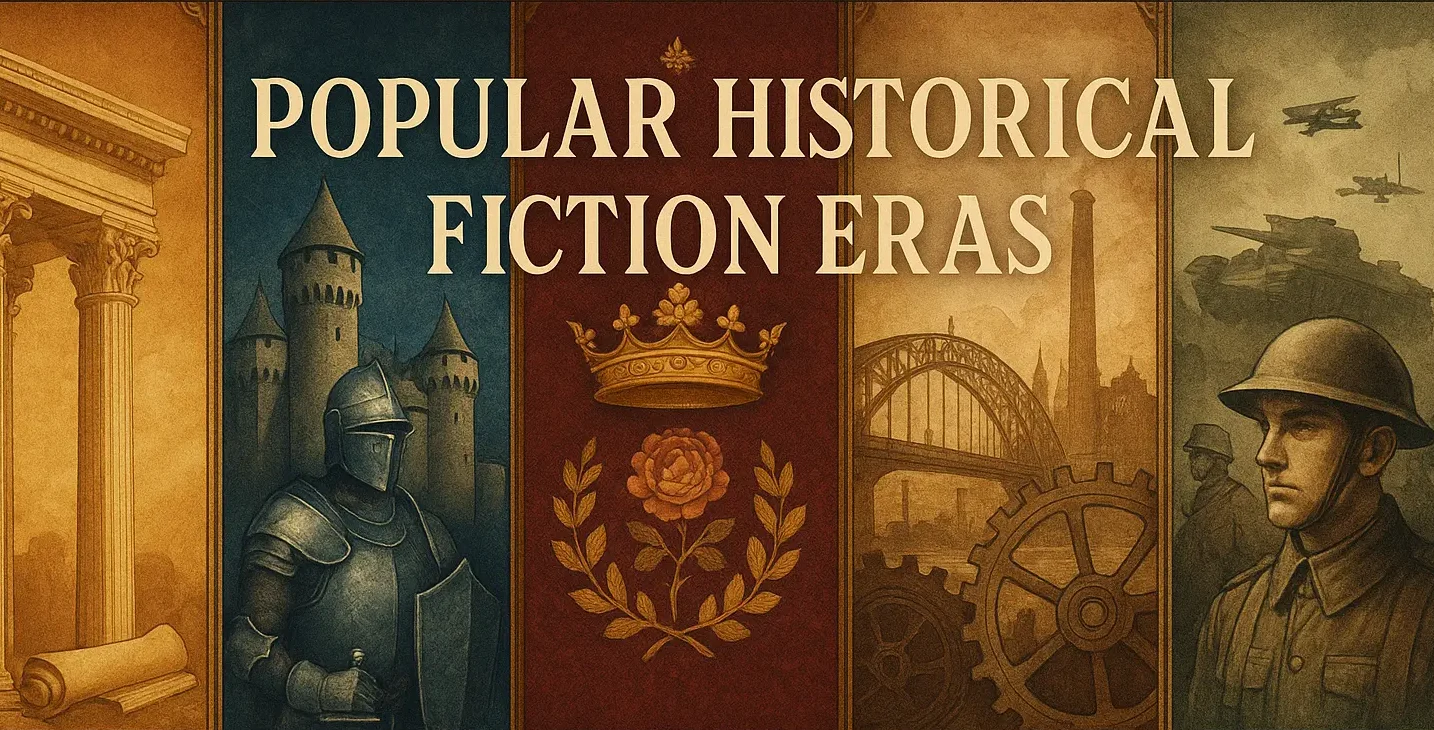

Historical fiction spans thousands of years of human history, but certain eras consistently capture readers’ imaginations more than others. From the glory of Ancient Rome to the drama of World War II, these popular time periods offer rich settings for compelling stories that blend historical authenticity with engaging narratives.
Whether you’re drawn to the political intrigue of Tudor courts, the epic battles of medieval warfare, or the social upheaval of Victorian society, understanding which historical periods dominate the genre helps you discover books that match your interests and explore new eras you might love.
This comprehensive guide explores the most popular time periods in historical fiction, what makes each era compelling, and recommendations for where to start your journey through history’s most beloved fictional settings.
Why Certain Time Periods Dominate Historical Fiction
Before diving into specific eras, it’s worth understanding why some historical periods inspire more fiction than others.
Dramatic Historical Events
Periods marked by war, revolution, political upheaval, or social transformation naturally provide dramatic backdrops for storytelling. The inherent conflict and stakes make these eras ideal for compelling narratives.
Available Historical Records
Authors need sufficient historical documentation to create authentic settings while maintaining enough gaps to insert fictional characters and events. The “sweet spot” periods have good records without being so recent that every detail is documented.
Cultural Fascination
Some periods capture the popular imagination through their distinctive cultures, iconic figures, or romanticized popular perception. These eras feel familiar enough to be accessible while offering enough exoticism to be intriguing.
Visual Distinctiveness
Periods with strong visual identities, distinctive clothing, architecture, and cultural markers help readers immediately recognize and engage with the setting. Think of knights in armor, Tudor gowns, or Victorian top hats.
Modern Relevance
The most popular periods often resonate with contemporary concerns. Medieval power struggles reflect modern politics, Victorian social change mirrors current debates, and World War II stories explore timeless questions about morality and courage.
The Top 10 Most Popular Historical Fiction Time Periods
1. World War II (1939-1945)

Why It’s Popular: World War II is arguably the most popular setting in historical fiction. The war’s global scope, clear moral stakes, dramatic events, and relatively recent timing make it an endlessly fascinating subject. Living memory, extensive documentation, and universal impact create powerful opportunities for both epic and intimate storytelling.
Common Themes:
- The Holocaust and Jewish experience
- Resistance movements and espionage
- Home front stories
- Pacific and European theaters
- Post-war recovery and trauma
- Code-breaking and intelligence work
What Makes It Compelling: The war touched nearly every corner of the globe, offering diverse perspectives from soldiers, civilians, resistance fighters, prisoners of war, and those on the home front. The clear moral dimension, combined with complex individual choices, creates rich material for character development.
Popular Sub-Periods:
- Pre-war rise of fascism (1933-1939)
- The Blitz and Battle of Britain (1940-1941)
- Holocaust period (1941-1945)
- D-Day and the liberation of Europe (1944-1945)
- Pacific War and the atomic bomb (1941-1945)
- Immediate post-war period (1945-1950)
Recommended Starting Points:
- All the Light We Cannot See by Anthony Doerr
- The Nightingale by Kristin Hannah
- The Book Thief by Markus Zusak
- Atonement by Ian McEwan
Reader Appeal: Military history enthusiasts, those interested in moral complexity, readers seeking emotional depth, and anyone fascinated by this pivotal moment in modern history.
2. Tudor England (1485-1603)
Why It’s Popular: The Tudor dynasty offers everything historical fiction readers love: powerful personalities, court intrigue, religious conflict, dramatic executions, and larger-than-life figures like Henry VIII and Elizabeth I. The period’s relatively good documentation, combined with enduring mysteries, makes it ideal for both accurate historical fiction and creative interpretation.
Common Themes:
- Henry VIII’s six wives and the break from Rome
- Elizabeth I’s reign and the Virgin Queen
- Court intrigue and political maneuvering
- Religious conflict (Catholic vs. Protestant)
- The rise of England as a naval power
- Women’s limited but sometimes influential roles
What Makes It Compelling: The Tudors lived dramatic lives that read like fiction even in historical accounts. Palace intrigue, beheadings, secret marriages, religious persecution, and power struggles create natural narrative drama. The period also offers strong, complex female figures in a male-dominated world.
Popular Figures:
- Henry VIII and his six wives
- Elizabeth I
- Thomas Cromwell
- Anne Boleyn
- Mary, Queen of Scots
- Sir Walter Raleigh
Recommended Starting Points:
- Wolf Hall by Hilary Mantel
- The Other Boleyn Girl by Philippa Gregory
- The Queen’s Gambit by Elizabeth Fremantle
- Dissolution by C.J. Sansom (Shardlake series)
Reader Appeal: Fans of political intrigue, royal history enthusiasts, readers who enjoy strong female characters, and those interested in religious history.
3. Ancient Rome (753 BC – 476 AD)
Why It’s Popular: Ancient Rome’s millennium-long history encompasses everything from the rise of the Republic to the fall of the Empire. Military conquest, political intrigue, gladiatorial combat, and the foundations of Western civilization provide endless storytelling opportunities. The Romans’ detailed record-keeping provides authors with a solid historical foundation, while legends and gaps offer creative freedom.
Common Themes:
- Rise and fall of Julius Caesar
- Gladiators and arena combat
- Roman military campaigns and legions
- Political intrigue in the Senate
- Daily life in Rome and provinces
- Christianity’s emergence and persecution
- Decline and fall of the Empire
What Makes It Compelling: Rome offers spectacle (gladiators, chariot races, triumphs), political sophistication (Senate intrigue, civil wars), military action (legion battles, conquests), and dramatic historical figures. The period also provides a “familiar yet foreign” setting, recognizable through popular culture but exotic enough to fascinate.
Popular Sub-Periods:
- Roman Republic (509-27 BC)
- Julius Caesar and civil wars (49-31 BC)
- Augustus and Julio-Claudian dynasty (27 BC – 68 AD)
- Height of Empire (96-192 AD)
- Crisis and decline (235-476 AD)
Recommended Starting Points:
- I, Claudius by Robert Graves
- The First Man in Rome by Colleen McCullough
- Pompeii by Robert Harris
- The Eagle of the Ninth by Rosemary Sutcliff
Reader Appeal: Military history fans, those interested in classical civilization, readers who enjoy political intrigue, and anyone fascinated by ancient history.
4. Victorian Era (1837-1901)
Why It’s Popular: Queen Victoria’s 63-year reign was marked by significant social change, industrialization, scientific advancements, and British imperial expansion. The period’s rigid social structures, in contrast to the rapid change, create fascinating tensions. Gas-lit London, societal hypocrisy, women’s constrained lives, and class divisions offer rich material for drama.
Common Themes:
- Social class and restrictions
- Women’s limited rights and opportunities
- Industrial Revolution impacts
- Urban poverty contrasted with wealth
- Scientific discoveries challenging religion
- Colonial expansion
- Crime and the emergence of detective work
What Makes It Compelling: Victorian society’s strict surface respectability, hiding darker realities, creates natural dramatic tension. The period witnessed massive social change, urbanization, the beginnings of women’s suffrage, and labor movements, while maintaining rigid social hierarchies. It’s recent enough to feel relatable but foreign enough to be exotic.
Popular Sub-Genres:
- Victorian mysteries (Sherlock Holmes era)
- Gothic Victorian fiction
- Industrial/social reform novels
- Colonial adventure stories
- Victorian romance with social commentary
Recommended Starting Points:
- Fingersmith by Sarah Waters
- The Crimson Petal and the White by Michel Faber
- The Essex Serpent by Sarah Perry
- The Miniaturist by Jessie Burton
Reader Appeal: Mystery lovers, readers interested in social history, those fascinated by manners and restrictions, and fans of atmospheric gothic fiction.
5. Medieval Europe (5th-15th Century)
Why It’s Popular: Medieval Europe offers castles, knights, crusades, plague, and the epic scope of centuries of conflict and cultural development. The period’s romantic popular image (castles, chivalry) contrasts with harsh historical realities (disease, warfare, poverty), creating opportunities for both adventure and gritty realism.
Common Themes:
- Knights, chivalry, and warfare
- Crusades and religious conflict
- Castle sieges and feudal politics
- The Black Death and medieval medicine
- Monasteries and religious life
- Vikings and Norse invasions
- Arthurian legends and mythology
What Makes It Compelling: Medieval Europe offers an epic scope, spanning centuries of history across an entire continent. Limited but evocative historical records allow authors creative freedom while maintaining authenticity. The period offers both spectacular military action and intimate stories of faith, survival, and daily life.
Popular Sub-Periods:
- Early Medieval/Dark Ages (5th-10th century)
- High Medieval period (11th-13th century)
- Late Medieval period (14th-15th century)
- Specific events: Crusades (1095-1291), Wars of the Roses (1455-1487)
Recommended Starting Points:
- The Pillars of the Earth by Ken Follett
- The Last Kingdom by Bernard Cornwell
- The Name of the Rose by Umberto Eco
- Ivanhoe by Sir Walter Scott
Reader Appeal: Fantasy readers seeking historical grounding, military history enthusiasts, those interested in medieval warfare and castles, and readers who enjoy epic scope.
6. Regency Era (1811-1820)
Why It’s Popular: Though technically just nine years, the broader “Regency period” (roughly 1795-1837) dominates historical romance. Jane Austen’s novels have created an enduring fascination with the social rules, courtship rituals, and witty dialogue of this era. The period’s distinctive fashion, architecture, and social customs create a recognizable setting beloved by millions.
Common Themes:
- Courtship and the marriage market
- Social class and propriety
- Limited options for women
- Napoleonic Wars as backdrop
- Country estates and the London season
- Scandal and social ruin
- Wit, manners, and social navigation
What Makes It Compelling: Regency fiction offers a perfect blend of romance, social commentary, and historical detail. Strict social rules create dramatic tension—one misstep can ruin reputations. The period’s elegance and wit appeal to readers seeking lighter historical fiction with romantic elements.
Popular Sub-Genres:
- Regency romance (dominant sub-genre)
- Regency mysteries
- Historical fiction with a Napoleonic War backdrop
- Social satire in Austen’s tradition
Recommended Starting Points:
- Jane Austen’s novels (Pride and Prejudice, Emma, Persuasion)
- Jonathan Strange & Mr Norrell by Susanna Clarke
- The Duke and I by Julia Quinn (Bridgerton series)
- Georgette Heyer’s Regency romances
Reader Appeal: Romance readers, those who love Jane Austen, readers seeking lighter historical fiction with social commentary, and fans of period drama.
7. American Civil War Era (1861-1865)
Why It’s Popular: The Civil War represents America’s most dramatic internal conflict, addressing slavery, national identity, and the nation’s future direction. The war’s clear moral dimension, combined with complex regional and personal loyalties, creates powerful narrative tension. Extensive documentation and personal accounts provide rich source material.
Common Themes:
- Slavery and abolition
- Brother-against-brother conflicts
- Battles and military campaigns
- Home front struggles
- Reconstruction period
- African American experiences
- Southern society and plantation life
What Makes It Compelling: The Civil War’s moral stakes, dramatic battles, and lasting impact on American identity make it a profoundly relevant subject. Personal stories of divided families, soldiers’ experiences, and the fight for freedom resonate across time. The period also forces examination of American ideals versus reality.
Popular Perspectives:
- Union soldiers and leadership
- Confederate soldiers and civilians
- Enslaved people seeking freedom
- Women on the home front
- Border state experiences
- Reconstruction period challenges
Recommended Starting Points:
- Cold Mountain by Charles Frazier
- The Killer Angels by Michael Shaara
- March by Geraldine Brooks
- Gone with the Wind by Margaret Mitchell (with a critical eye)
Reader Appeal: American history enthusiasts, readers interested in moral complexity, those interested in military history, and anyone fascinated by this pivotal period.
8. World War I (1914-1918)
Why It’s Popular: The “Great War” marked the end of an era and the beginning of modernity. The war’s senseless slaughter, trench warfare horror, and society-wide trauma create powerful emotional resonance. Often overshadowed by World War II, WWI fiction is experiencing a resurgence as readers discover this complex and transformative period.
Common Themes:
- Trench warfare horror
- Lost generation trauma
- Collapse of the old social order
- Women’s changing roles
- Shell shock and psychological impact
- Poetry and literature of war
- Home front struggles
What Makes It Compelling: WWI marks a significant departure from the past. The war destroyed old certainties and ushered in modern consciousness. The contrast between pre-war optimism and wartime horror, combined with the war’s tragic waste of life, creates emotionally powerful stories. The period also saw massive social change, particularly for women.
Popular Perspectives:
- Soldiers in trenches (Western Front focus)
- Nurses and medical personnel
- Home front civilians
- Conscientious objectors
- Post-war “lost generation”
- Eastern Front and other theaters
Recommended Starting Points:
- Birdsong by Sebastian Faulks
- Regeneration by Pat Barker
- A Farewell to Arms by Ernest Hemingway
- The Guns of August by Barbara Tuchman (non-fiction)
Reader Appeal: Readers seeking emotional depth, those interested in the psychological impact of war, fans of literary historical fiction, and anyone interested in early 20th-century history.
9. Ancient Greece (8th Century BC – 6th Century AD)
Why It’s Popular: Ancient Greece gave the world democracy, philosophy, theater, and epic mythology. While less extensively covered than Roman history, Greek history offers a rich array of material, ranging from mythological retellings to historical accounts of city-states, philosophers, and the Persian Wars. The Trojan War and Greek mythology, in particular, inspire modern retellings.
Common Themes:
- Greek mythology retellings
- Trojan War stories
- Athenian democracy and philosophy
- Sparta and military culture
- Persian Wars
- Alexander the Great’s conquests
- Olympic Games and athletic culture
What Makes It Compelling: Greek history blends familiar mythology with historical events, offering both fantasy elements and authentic historical settings. Dramatic conflicts (Trojan War, Persian Wars, Peloponnesian War), philosophical depth, and iconic figures create compelling narratives. The recent trend of retelling mythological stories has sparked renewed interest.
Popular Sub-Periods:
- Mycenaean Greece (Bronze Age, 1600-1100 BC)
- Archaic period (800-500 BC)
- Classical Greece (500-323 BC)
- Hellenistic period (323-31 BC)
Recommended Starting Points:
- The Song of Achilles by Madeline Miller
- Circe by Madeline Miller
- Gates of Fire by Steven Pressfield
- The King Must Die by Mary Renault
Reader Appeal: Mythology enthusiasts, readers interested in philosophy and democracy’s origins, those who enjoy epic warfare, and fans of literary retellings.
10. Early America/Colonial Period (1600-1800)
Why It’s Popular: The founding period of America offers a rich tapestry of exploration, conflict between cultures, revolution, and nation-building drama. The period’s defining events, colonization, the Revolutionary War, and the creation of the Constitution, shaped modern America. Stories range from Puritan settlements to frontier adventures to Revolutionary War heroics.
Common Themes:
- Colonization and settlement
- Conflicts with Native Americans
- Puritan life and witch trials
- Revolutionary War
- Founding Fathers
- Frontier life and exploration
- Slavery in the colonial period
What Makes It Compelling: Early American history involves civilization-building, cultural conflict, religious extremism, revolution, and the founding of a nation. The period offers both epic scope (revolution, war) and intimate stories (settlers, communities). Questions about American identity and values remain relevant.
Popular Sub-Periods:
- Early colonization (1600-1650)
- Puritan New England (1630-1700)
- Colonial period (1700-1775)
- Revolutionary War (1775-1783)
- Early Republic (1783-1800)
Recommended Starting Points:
- The Crucible by Arthur Miller (play)
- The Last of the Mohicans by James Fenimore Cooper
- My Name Is Mary Sutter by Robin Oliveira
- March by Geraldine Brooks
Reader Appeal: American history enthusiasts, readers interested in nation-founding, those fascinated by colonial life, and anyone interested in the Revolutionary War.
Emerging and Growing Time Periods
While the above represent the most established popular periods, several eras are growing in prominence:
The Roaring Twenties (1920s)
Jazz Age glamour, prohibition, women’s liberation, and cultural revolution make the 1920s increasingly popular. The period’s distinctive style and social change attract readers seeking both historical depth and visual appeal.
Ancient Egypt
Pharaohs, pyramids, and mysterious practices fascinate readers. While less common than those of Greece or Rome, Egyptian settings are gaining popularity, particularly in portrayals featuring powerful female figures like Cleopatra or Nefertiti.
Viking Age and Dark Ages
Norse culture, exploration, and mythology attract readers seeking alternatives to medieval Europe. Bernard Cornwell’s Saxon Stories and recent TV adaptations have significantly boosted interest.
Gilded Age America (1870s-1900)
Industrial growth, the rise of robber barons, massive wealth inequality, and social change make this period increasingly relevant to contemporary readers. HBO’s The Gilded Age sparked renewed interest.
Renaissance Italy
Beyond Tudor England, Renaissance Italy offers art, intrigue, powerful families (such as the Medici and Borgia), and a cultural revolution. Growing but still niche compared to Tudor dominance.
How to Choose Your Favorite Time Period
Consider What You Enjoy
Love action and warfare? → Medieval Europe, Ancient Rome, World Wars
Prefer political intrigue? → Tudor England, Ancient Rome, Victorian Era
Seeking romance and manners? → Regency Era, Victorian Era
Want moral complexity? → World War II, Civil War, World War I
Fascinated by social change? → Victorian Era, 1920s, Civil War Era
Enjoy mythology elements? → Ancient Greece, Viking Age
Start With Familiar Periods
If you’ve enjoyed historical dramas on TV or film, try books set in those periods. Loved Downton Abbey? Try Edwardian/WWI fiction. Enjoyed The Crown? Explore mid-20th-century Britain.
Explore Beyond the Popular
While popular periods offer abundant choices, don’t overlook less common eras. Ancient Persia, medieval China, or early modern Japan offer fresh perspectives and unique stories.
Follow Your Interests
Interested in women’s history? Tudor England and the Victorian Era offer strong female perspectives. Fascinated by military history? Ancient Rome and World Wars provide detailed military action. Love social history? The Victorian Era and the Gilded Age explore class and change.
Why Popular Doesn’t Always Mean Best
Popular time periods offer an abundance of book choices, familiar settings, and easy entry points. But don’t let popularity limit you:
Popular periods can feel overdone. Tudor England has been extensively covered; finding fresh perspectives can be challenging.
Lesser-known periods offer discovery. Books set in medieval China, pre-Columbian America, or Byzantium provide fresh experiences.
Your interests matter most. If you’re passionate about a specific period, explore it regardless of popularity.
Quality varies. Popular periods attract many authors, including weaker writers following trends. Less popular periods may have fewer but higher-quality offerings.
The Role of TV and Film
Popular time periods often gain momentum from successful adaptations:
- Tudor England: The Tudors, Wolf Hall
- Regency Era: Bridgerton, Pride and Prejudice adaptations
- WWII: Countless films and series
- Medieval/Viking: Game of Thrones, Vikings, The Last Kingdom
- Victorian: Sherlock, Penny Dreadful
These adaptations introduce periods to new audiences and inspire reading. If you’ve enjoyed a historical show, exploring related fiction is a natural next step.
Conclusion
Historical fiction’s most popular time periods, including World War II, Tudor England, Ancient Rome, the Victorian Era, Medieval Europe, and others, dominate for good reason. They offer dramatic events, well-documented history, combined with creative freedom, compelling characters, and themes that resonate across time.
Whether you’re drawn to the moral stakes of World War II, the court intrigue of Tudor England, the military might of Ancient Rome, or the social complexity of Victorian society, these popular periods provide endless reading opportunities. Each era offers unique appeals; some provide action and warfare, others political intrigue, and still others social drama and romance.
The beauty of historical fiction lies in its ability to transport readers across time, offering windows into how people lived, loved, fought, and survived in different eras. While popular periods offer easy entry points and abundant choices, don’t let popularity limit your exploration. History spans thousands of years and countless cultures; there’s always another fascinating period waiting to be discovered.
Start with what intrigues you, whether it’s a familiar period or one that’s completely new. The most popular time periods became popular because they offer compelling stories, but your perfect historical fiction era is whichever one captures your imagination and won’t let go.
Frequently Asked Questions
What is the most popular time period for historical fiction?
World War II is the most popular time period in historical fiction. The war’s global scope, clear moral stakes, dramatic events, and relatively recent timing make it endlessly compelling for both authors and readers. The Holocaust, resistance movements, home front stories, and military campaigns offer diverse perspectives and emotional depth that continue to resonate with modern audiences.
Why is Tudor England so popular in historical fiction?
Tudor England is characterized by larger-than-life historical figures (Henry VIII, Elizabeth I), dramatic events (beheadings, religious conflict, court intrigue), powerful female characters, and excellent historical documentation. The period’s inherent drama, with its six wives, political maneuvering, and religious upheaval, reads like fiction even in historical accounts, making it ideal for novels while offering enough creative space for fictional characters and plots.
What historical period has the most books?
World War II likely has the most historical fiction books published, followed closely by Tudor England and the American Civil War. However, if you expand to include the broader medieval period (covering several centuries), it might rival or exceed WWII in total number of titles. Victorian England and Ancient Rome also have extensive libraries of historical fiction.
Is Ancient Rome or Ancient Greece more popular in historical fiction?
Ancient Rome is significantly more popular in historical fiction than Ancient Greece. Rome’s longer historical span, extensive military campaigns, gladiatorial culture, and detailed historical records provide more material for traditional historical fiction. However, Ancient Greece is experiencing a renaissance through mythological retellings (like Madeline Miller’s works), which blend mythology with historical fiction.
Why is Regency fiction so popular when it’s such a short time period?
The Regency era’s popularity stems largely from Jane Austen’s enduring influence and the rise of historical romance as a genre. The period’s distinctive social rules, courtship rituals, elegant fashion, and witty dialogue create a recognizable, appealing setting. Regency fiction often emphasizes romance and social navigation over military or political events, appealing to readers seeking lighter, relationship-focused historical fiction.
What’s the least popular historical time period in fiction?
Certain periods remain relatively underexplored in historical fiction, including the Early Middle Ages (often referred to as the “Dark Ages” due to the limited records), most of medieval Asia, pre-colonial Africa, and ancient American civilizations. However, “least popular” varies by market; some periods underrepresented in English-language fiction are popular in other languages or regional markets.
Do popular historical periods change over time?
Yes, popular historical periods shift in response to cultural interests, recent events, and media adaptations. For example, World War I fiction has experienced significant growth in recent years, the Viking Age has gained popularity following TV shows like Vikings and The Last Kingdom, and the 1920s are witnessing a renewed interest. Historical fiction often reflects contemporary concerns; periods that speak to current issues tend to gain readership.
How do I know which historical period I’ll enjoy reading about?
Start with periods you already find interesting from history classes, documentaries, or TV shows. Consider what you enjoy in fiction generally. If you love romance, try the Regency or Victorian eras; if you prefer action, explore Ancient Rome or Medieval warfare; if you want moral complexity, try the WWII or American Civil War periods. Most importantly, sample different periods through shorter books or highly-recommended titles to discover what resonates with you.
